Unblended, Single Source, Single Origin — What Makes Pahari Haat Honey Genuinely Different
Quick Answer: Unblended honey comes from a single batch, never mixed with other sources. Single source means one geographic ecosystem. Single origin means one traceable origin. Pahari Haat Himalayan Jungle Honey is all three — sourced exclusively from the Shivalik forest range of Uttarakhand, never blended, never mixed. Every jar tells one story, from one landscape.
There is a jar of honey sitting on most Indian kitchen shelves right now.
Golden. Smooth. Consistent — the same colour, the same texture, the same taste it has had for years. Every batch identical to the last.
That consistency is not natural. Honey made by bees foraging on wildflowers across different forests and different seasons should never look or taste exactly the same twice. The fact that it does is the first signal that something happened between the hive and your jar — something that erased the honey's identity before you opened it.
That something is blending.
What Blending Does to Honey — And Why Most Brands Do It
When honey arrives at a large processing facility, it comes from dozens of sources. Wildflower honey from Uttarakhand. Plains honey from Rajasthan. Farmed honey from Maharashtra. Mountain honey from Himachal. Different colours. Different moisture levels. Different viscosities. Different flavour profiles.
A commercial processor blends all of it.
The reason is practical — and it has nothing to do with you. Blending creates a consistent product that behaves predictably in industrial bottling machinery. It creates a colour that photographs well. It creates a taste that is recognizable batch after batch, year after year.
What it destroys in the process is everything that made each of those honeys worth drinking in the first place.
The botanical character of a Shivalik forest corridor. The specific floral notes of a particular rhododendron bloom season. The dark amber colour that signals antioxidant density from medicinal plants in the Jim Corbett forest belt. The subtle herbal undertone that shifts between spring and autumn harvests in the Nainital foothills.
All of it erased. Standardized. Made interchangeable.
The honey in the blended jar tastes like honey. It does not taste like anywhere.

Three Words That Mean Something Different
Unblended. Single source. Single origin.
These three phrases are sometimes used interchangeably in food marketing. They are not the same thing — and understanding the difference is what separates informed honey buyers from everyone else.
Unblended means the honey in your jar has not been mixed with honey from other batches, other sources, or other regions. What the bees produced from one harvest is what you receive — without dilution, without standardization, without the addition of any other honey to hit a target price point or colour profile.
Single source means the honey comes from one specific geographic ecosystem. Not a vague region. Not a state. One ecosystem — one forest corridor, one mountain range, one collection zone — where the flora, altitude, climate, and soil create a specific and identifiable character in the honey.
Single origin means the honey has one traceable origin — one identifiable point where it came from, handled by one set of hands, through one sourcing chain. The opposite of single origin is honey that could have come from anywhere, passed through any number of intermediaries, and tells you nothing about its past.
Together, these three qualities create something the blended commercial market cannot offer: honey with an identity.
The Shivalik Forest Range — Jim Corbett, Nainital, One Character
Pahari Haat Himalayan Jungle Honey is harvested from the Shivalik Himalayan range — the southernmost fold of the Himalayas — across the wild forest zones of Jim Corbett, Nainital, and the surrounding Kumaon foothills. The honey is then brought to Pahari Haat's facility in Kasar Devi, Almora, where it is graded, strained through muslin cloth, and packed.
This is a specific landscape. Not "the Himalayas" in the vague, catch-all sense that appears on dozens of commercial honey labels. The Shivalik forest corridor — one of India's most biodiverse wildlife and botanical zones, where the dense sal and teak forests of Jim Corbett meet the oak and rhododendron forests climbing toward the Nainital hills.
The bees that produce this honey forage within this single ecosystem — across forests of rhododendron, wild thyme, sal blooms, alpine wildflowers, deodar and oak, Himalayan herbs and medicinal plants that thrive in the specific microclimate of this corridor.
Each of these plants contributes something to the nectar. The rhododendron adds floral depth. The wild thyme adds a herbaceous edge. The alpine wildflowers add sweetness and complexity. The medicinal plants growing in the Shivalik biodiversity corridor — in soil that has never been farmed or treated — add the polyphenol density that gives genuine Himalayan forest honey its characteristic dark amber colour and its measurably higher antioxidant content compared to plains honey.
That is the character of Pahari Haat honey. Specific, identifiable, seasonal, and irreplaceable. It cannot be replicated by blending honey from other sources. It can only come from this one place.
Why Seasonal Variation Is a Feature, Not a Bug
Open a jar of Pahari Haat honey from a spring harvest and compare it side by side with an autumn harvest jar.
They will not be identical.
The spring jar will be lighter in colour — the early mountain blooms of rhododendron and fruit trees produce a honey with different floral notes and a slightly different amber. The autumn jar will be darker — the late-season wildflowers and forest herbs push the polyphenol content higher, deepening the colour and intensifying the aroma.
This variation is not inconsistency. It is authenticity.
It is what happens when honey comes from one specific ecosystem through different seasons — when the bees' forage changes with the mountain calendar, and the honey changes with it.
Blended commercial honey eliminates this variation deliberately. Every batch is standardized to match the previous one. The autumn jar looks exactly like the spring jar, the summer jar, the jar from three years ago.
This sameness is a manufacturing achievement. It is not a natural one.
When customers notice that their Pahari Haat honey looks slightly different from the last jar — slightly darker, or with a different crystallization pattern, or with a subtly different aroma — that difference is the most honest thing about it. It means the honey came from somewhere real, at a specific time, when specific flowers were blooming in the Jim Corbett forest belt.
What Single Origin Means for Traceability
One of the most valuable qualities of single origin food — and one of the least discussed — is traceability.
When honey comes from one origin, it can be traced. The sourcing region is known. The beekeepers are known. The forest ecosystem is documented. The harvest season is identifiable. If a question arises about the honey — about its character, its purity, its composition — there is a chain of accountability that leads back to a specific place and specific people.
When honey is blended from multiple sources, traceability disappears. The contents of that jar may have come from dozens of suppliers across multiple states. Each supplier may have sourced from dozens of beekeepers. The chain of accountability dissolves into an anonymous supply network.
This is not a theoretical concern. India has documented honey adulteration problems — sugar syrups, glucose solutions, rice syrup — added at various points in supply chains that involve too many hands and too little visibility.
Single origin is not a guarantee against adulteration. But it is the foundation on which a credible guarantee can be built. You cannot verify what you cannot trace.
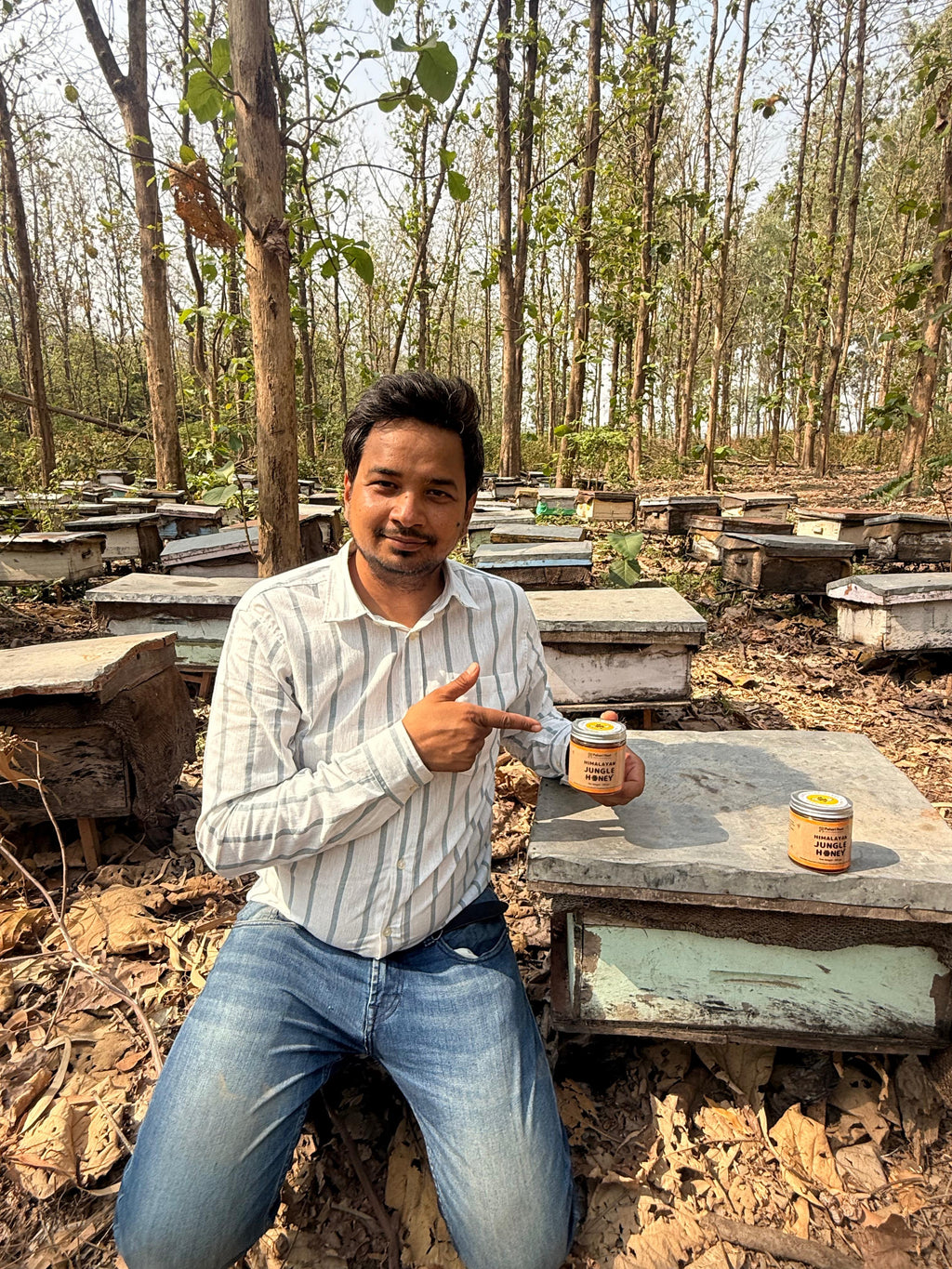
At Pahari Haat, Gaurav Agarwal has personally visited every beekeeper in the sourcing network. He knows the Jim Corbett forest zones and Nainital foothills where each colony forages — where the Shivalik range creates a biodiversity corridor unlike anywhere else in India. He has trained each beekeeper in sealed-only harvesting — extracting honey only when the bees have fully capped the honeycomb with beeswax, which is the bees' own signal that the honey is ready. He pays above-market rate specifically to make ethical, traceable practice financially sustainable for the beekeepers themselves.
That is what single origin means in practice. Not a label. A relationship.
The Contrast — What Blended Honey Cannot Tell You
Pick up a mass-market honey jar and ask: where exactly did this come from?
You will get an answer like "the Himalayas" or "forest sources across India" or "selected beekeepers." These are not answers. They are descriptions of a supply strategy. They tell you nothing about the specific ecosystem, the altitude, the flora, the season, or the beekeeper who harvested it.
This vagueness is not carelessness. It is structural. When honey is blended from dozens of sources to hit price points and consistency targets, specific origin information becomes impossible to provide — because there is no single origin to point to.
The language of blended honey is always plural: sources, regions, beekeepers, forests. The language of single origin honey is always specific: the Shivalik forest corridor, Jim Corbett and Nainital foothills, the spring wildflower bloom, Gaurav's beekeepers in the Kumaon forest belt — with packing at Kasar Devi, Almora.
One tells a story. The other describes a category.
How to Taste the Difference
You do not need a laboratory or a food scientist to experience what single source, single origin, unblended honey tastes like compared to blended commercial honey.
You need two jars and five minutes.
Step 1 — Smell first: Open both jars before tasting. Blended commercial honey has a flat, uniformly sweet aroma — the volatile compounds that create origin-specific character have been processed out. Genuine single source honey from the Shivalik forest zone has a layered aroma — floral, slightly earthy, with herbal undertones from the Jim Corbett forest corridor. You may not be able to name every note. You will notice that something is there.
Step 2 — Taste slowly: Take a small amount of each on a clean spoon without mixing. Commercial honey tastes sweet — and that is broadly the extent of it. Single origin Himalayan honey tastes sweet first, then something else: a floral warmth, a slight edge, a finish that lingers for thirty seconds after you swallow. The complexity is not dramatic. It is simply present, where the commercial version has none.
Step 3 — Look at the colour: Genuine unblended, never-heated honey from the Shivalik forest sources is dark amber — the carotenoids and polyphenols from medicinal wildflowers give it colour that no processing can add back after the fact.
Step 4 — Wait: Leave the jar at room temperature for three to six months. Check whether your honey crystallizes. Blended commercial honey — heated and ultra-filtered to prevent exactly this — will stay liquid. Genuine unblended raw honey crystallizes naturally, because its natural glucose content, its pollen, and its unheated composition are all intact.
The crystallization tells you everything that the label cannot.
Why This Matters Beyond Taste
The conversation about unblended, single source, single origin honey is not only about flavour. It is about what the food system rewards.
When buyers choose blended commercial honey, they reward a system built on anonymization — sources that cannot be named, beekeepers who cannot be credited, ecosystems that are extracted from rather than supported.
When buyers choose single origin honey from a traceable source, they reward transparency. The beekeepers in the Jim Corbett forest belt and Nainital foothills whose colonies produce this honey are paid above market rate. The sustainable harvesting practices they follow — sealed-only harvest, right-season timing, no sugar feeding — are financially viable because buyers are willing to pay for what these practices produce.
This is not charity. It is the honest economics of genuine food.
Every jar of Pahari Haat honey is a direct expression of the Shivalik forest ecosystem, the seasonal wildflower calendar, and the specific people who tend those forest bee colonies. The honey is harvested in Jim Corbett and the Nainital foothills. It is packed with care in Kasar Devi, Almora. Those two places are part of one story — and that story is inseparable from what is in the jar.
The forests make this honey. The beekeepers tend the colonies. The mountains give it character. Kasar Devi sends it to you.
Everything else is just a jar.
Read More from Pahari Haat
Frequently Asked Questions
What is unblended honey? Unblended honey has not been mixed with honey from other batches, sources, or regions. Every jar comes from one harvest, one ecosystem, without standardization or dilution. The taste, colour, and character reflect one specific origin — not an industrial blend designed for consistency.
What does single source honey mean? Single source honey comes from one specific geographic ecosystem rather than multiple collection zones. Pahari Haat honey is harvested exclusively from the Shivalik forest corridor — Jim Corbett forest belt and Nainital foothills — one landscape with one identifiable botanical character.
What is single origin honey? Single origin honey has one traceable origin — one sourcing chain, one set of beekeepers, one geographic identity. Pahari Haat founder Gaurav Agarwal has personally visited every beekeeper in the Jim Corbett and Nainital sourcing network. The honey is harvested there and packed at Kasar Devi, Almora.
Why does unblended honey taste different from commercial honey? Because its botanical character is preserved intact rather than averaged out with dozens of other sources. Unblended honey from the Shivalik forest ecosystem reflects the specific plants, altitude, climate, and season of that place. Commercial blended honey reflects a manufacturing target.
Why does Pahari Haat honey vary between batches? Because the bees' forage changes with the season and the mountain flowering calendar in the Jim Corbett and Nainital foothills. Spring harvests differ from autumn harvests in colour, aroma, and flavour. This variation is authenticity, not inconsistency.
Is single origin honey better than regular honey? For taste complexity, traceability, and connection to a specific place — yes. Single origin honey carries an identity that blended commercial honey deliberately erases. Whether that matters depends on what you are looking for in the jar.
About Gaurav Agarwal: Founder of Pahari Haat, a women-led Himalayan wellness brand based in Kasar Devi, Almora, Uttarakhand. He spent two years personally building sourcing relationships with beekeepers across the Jim Corbett forest belt and Nainital foothills — visiting each one, training them in sealed-only harvesting practices, and paying above-market rates to make ethical beekeeping financially sustainable. Operating under Kartavya Karma Trust. FSSAI certified.
This article is for general informational purposes. Not medical advice.