Raw Honey vs Processed Honey — What's Actually Different and Why It Matters
Start with a simple question.
When you pick up a jar of honey at the supermarket — golden, smooth, perfectly clear — what do you think?
"Natural. Made by bees. Good for me."
Technically true. Bees did make it. But what is sitting in that jar has been through a factory. It has been heated. Filtered. Processed until it looks perfect.
What is left is sweet. It looks like honey. But a lot of what made it honey — the living, active, genuinely useful part — is gone.
This is that story. No complicated science. Just what actually happens between the hive and your kitchen shelf.
Quick Answer
Raw honey is honey that was never heated — strained through cloth to remove wax, poured into a jar, done. Everything the bees put in it is still there.
Processed honey is heated to 60–80°C in a factory, passed through ultra-fine filters, and bottled. It looks beautiful. It tastes sweet. But the enzymes, pollen, and antimicrobial compounds that make honey genuinely special are mostly gone.
Same raw material. Completely different product.
Shop Pahari Haat Himalayan Jungle Honey — Never Heated, ₹510 →
What Bees Actually Put In Honey
Before the comparison — a quick minute on what honey actually is when it leaves the hive. Because everything that follows is about how much of this survives.
Bees collect nectar from flowers. They carry it back to the hive, mix it with natural enzymes, and then fan it with their wings for days — evaporating water until the honey is ready. When it is done, they seal it with wax.
Inside that sealed cell:
Natural enzymes — including one called glucose oxidase, which continuously produces small amounts of hydrogen peroxide. This is what makes raw honey naturally antibacterial. It is why honey has been used on wounds for thousands of years. It is why raw honey never spoils. These enzymes begin breaking down above 45°C and are gone by 60°C.
Bee pollen — tiny grains that entered the honey naturally during production. Linked to immunity support. Also the geographic fingerprint of honey — pollen analysis can tell you exactly which flowers the bees visited and in which region. Ultra-filtration removes all of it.
Antioxidants — the compounds that give dark wild honey its deep amber colour. The darker the honey, the higher the antioxidant content. Heat degrades these. Filtration removes particles that carry them. Both make honey lighter in colour.
A complex aroma — hundreds of volatile compounds from the specific flowers bees visited, in a specific region, in a specific season. These evaporate when honey is heated.
This is honey fresh from the hive. A living food. What the factory does next determines how much of it survives.
What The Factory Does
Commercial honey processing has three goals — make it flow faster through machinery, extend shelf life, and create a consistent clear product that looks good on a shelf.
These are reasonable commercial goals. Here is what achieving them costs.
Heating to 60–80°C:
The glucose oxidase enzyme is destroyed. No more antimicrobial activity. The honey is now sweet and stable — but it is no longer antibacterial in any meaningful sense.
The complex aroma is gone. Volatile aromatic compounds evaporate with heat. Processed honey smells simply sweet. Raw honey smells like the landscape the bees came from.
The colour lightens. Antioxidants degrade. Dark amber becomes golden. The honey looks more appealing to most buyers — and is nutritionally poorer for it.
Ultra-filtration:
All pollen is removed. Every grain. The honey is now perfectly clear and completely untraceable to any geographic origin.
Propolis traces are removed. Propolis is the resin bees use to seal and sterilise the hive — it has natural antifungal properties. Gone.
What is left after heating and filtration is a very good natural sweetener. Real honey. Just a simplified version of it — with the most useful parts removed.
The Taste Difference — This Is Where It Gets Real
Forget the science for a moment. Just think about taste.
Raw honey from wild forest sources does not taste simply sweet. There is sweetness — but then something else. Floral notes. A slight warmth at the back of the throat. Sometimes a faint herbal undertone. A finish that lingers for a minute or two after you swallow.
It also changes slightly between batches. October harvest tastes a little different from March — because the bees visited different flowers in bloom. This is not inconsistency. It is honesty. The honey is telling you something about where it came from and when.
Commercially processed honey tastes sweet. Clean and sweet. Nothing else. The aromatic complexity that heat drove off, the character that pollen carried — all of it is gone. What remains is one-dimensional.
Most people who grew up eating commercial honey and taste genuinely raw honey for the first time say the same thing. It tastes like what they always imagined honey should taste like. Everything else, in retrospect, was a copy.
The Health Difference — Plain and Simple
The documented health benefits of honey — the ones people actually talk about — come from raw honey. Specifically from the enzymes and compounds that processing destroys.
Wound healing and skin: Raw honey applied to acne, cuts, or dry patches works because glucose oxidase is producing hydrogen peroxide — natural, low-level, antibacterial. This mechanism is only active in never-heated honey. Processed honey applied to skin is just sticky.
Immunity: Bee pollen — present in raw honey, removed by ultra-filtration — contains compounds associated with immune support. Pollen-free processed honey does not have access to these.
Digestion: Raw honey contains natural organic acids and enzyme activity that support gut health. These are temperature-sensitive. Processed honey loses them with heat.
Sleep: Half a teaspoon of raw honey before bed works because of the natural fructose-glucose balance that supports melatonin production. This balance is altered in processed honey.
Energy without crash: Raw honey's natural sugar ratio provides immediate energy from glucose followed by sustained energy from fructose — without the insulin spike and crash of refined sugar. This works best when the sugar ratio is natural and unaltered by processing.
For cooking and sweetening — processed honey is fine. The heat from cooking destroys enzymes regardless.
For everything else — only raw honey delivers.
The Crystallization Question — Let's Settle This
Raw honey crystallizes. It is not spoiled. It is not old. It is not fake.
Crystallization is the most reliable indicator that your honey is genuine.
Here is why it happens: honey contains natural glucose. At room temperature, over weeks or months, glucose slowly precipitates out of solution — forming crystals. The rate depends on the honey variety, temperature, and the presence of pollen grains that act as starting points for crystal formation.
Here is what crystallization tells you:
The honey was not heated above the temperature that prevents crystallization. Heated honey stays liquid for months because heat dissolves crystal formations.
The honey was not ultra-filtered to remove the pollen grains that trigger crystallization. Filtered honey resists crystallization because the starting points were removed.
The natural sugar balance is intact — certain adulterants alter this balance and prevent crystallization.
If your honey has been sitting perfectly liquid on your kitchen shelf for six months — it has been processed. Genuinely raw honey in Indian room temperatures crystallises within weeks to a few months.
To bring crystallised honey back to liquid: Place the sealed jar in a bowl of warm water — not hot, comfortably warm — and stir gently for 10-15 minutes. Done.
Do not microwave it. Do not pour boiling water over it. The point of buying never-heated honey is that it was never heated. Destroying it yourself at home defeats the entire purpose.
What Labels Actually Mean
"Raw" — not regulated in India. Any brand can print it. Means nothing legally.
"Pure" — means no sugar syrup was added. Can still be heavily heated and filtered.
"Natural" — means no artificial additives. Says nothing about processing temperature.
"Organic" — means bees foraged on organically certified land. Says nothing about whether the honey was heated.
"Never heated" or "Never heated at any stage" — this is the claim that matters. Ask brands what it specifically means in their process. A brand with genuinely never-heated honey can tell you exactly — no heat at extraction, no heat at straining, no heat at bottling. And their honey will crystallize in your kitchen to prove it.
Which Honey for What
For immunity, wound healing, acne, sleep: Raw never-heated honey. No substitutes.
For sweetening tea or coffee: Add it after the drink cools to comfortable drinking temperature. Adding raw honey to boiling tea destroys the same enzymes you paid a premium to preserve. Warm, not hot.
For cooking and baking: Either works. Cooking heat destroys enzymes regardless — so the advantage of raw honey is wasted above 50°C.
For skin and hair: Raw honey only. The antibacterial mechanism that makes it useful for skin only exists in never-heated honey.
For gifting: Raw honey. People who have never tasted genuinely raw honey before remember the first time. It is a gift that lands.
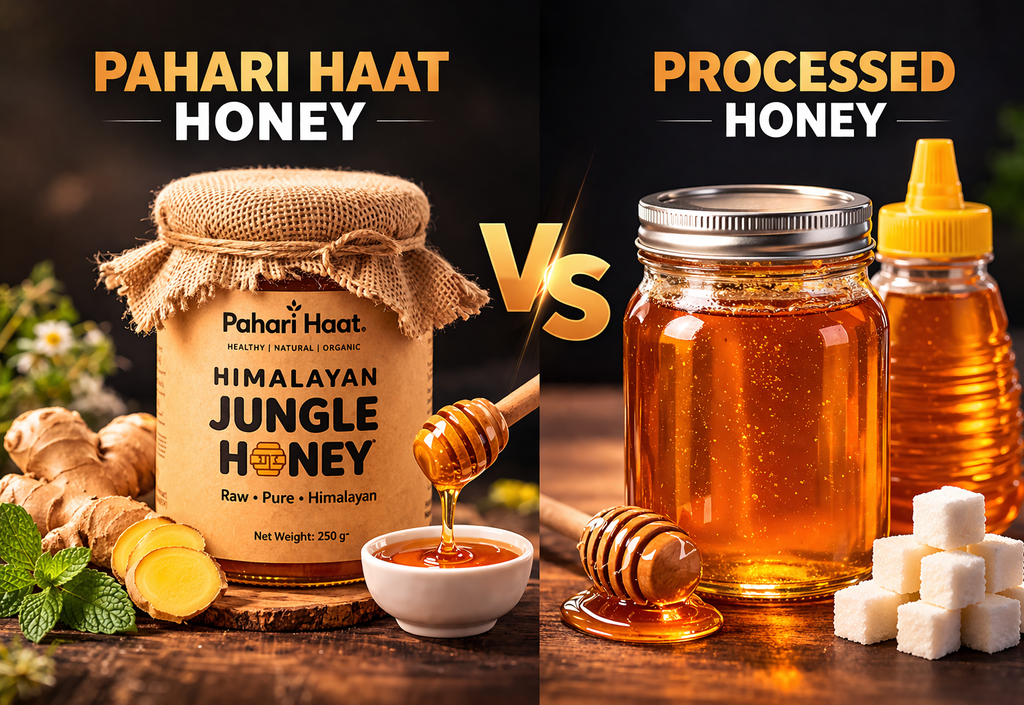
Pahari Haat Himalayan Jungle Honey — The One We Make
Our honey comes from wild bee colonies in the Kumaon forests of Uttarakhand.
Bees forage on rhododendron, wild thyme, Himalayan herbs, alpine wildflowers and ancient forest trees. The honey they produce is dark amber, complex in aroma, and genuinely different batch to batch — because the forest changes with season.
It is never heated at any stage. Extraction at ambient temperature. Strained through muslin cloth. Bottled at room temperature. Nothing else.
It will crystallize in your jar. That is the point.
👉 Shop Pahari Haat Himalayan Jungle Honey — ₹510, 250g, shipping included →
Side by Side
| Raw Honey | Processed Honey | |
|---|---|---|
| Heated? | Never | 60–80°C |
| Natural enzymes | Intact | Destroyed |
| Bee pollen | Present | Removed |
| Antibacterial? | Yes | No |
| Colour | Dark amber | Light golden |
| Crystallises? | Yes — proof of authenticity | No |
| Aroma | Complex, floral, layered | Simply sweet |
| Taste | Multi-layered | Flat sweet |
| Good for skin | Yes | No |
| Good for wounds | Yes | No |
| Good for sweetening | Yes | Yes |
The Short Version
Honey is one of the few foods that — when left completely alone — is perfect.
Bees have been making it for millions of years. They engineered it to never spoil, to heal wounds, to nourish whoever eats it. They got it right.
Commercial processing takes that perfect food and makes it look better, last longer, and flow through factory equipment. In doing so, it removes most of what made it genuinely useful.
Raw honey — never heated, never ultra-filtered, never adulterated — is what comes out of the hive. Crystallising, dark, complex, alive.
That is the one worth buying.
👉 Best Honey in India 2026 — Complete Buyer's Guide →
👉 Himalayan Jungle Honey Benefits — 10 Reasons →
👉 How to Test Honey Purity at Home →
👉 Honey with Warm Water — 8 Benefits →
👉 Raw Honey India — What It Really Is →
About Pahari Haat: Women-led Himalayan wellness brand. Kasar Devi, Almora, Uttarakhand. paharihaat.in
For informational purposes only. Not medical advice.