Never Heated Honey — What It Actually Means and Why Most "Raw" Honey Is Not
Quick Answer: Never heated honey is honey where no heat was applied at any stage — from extraction through straining to bottling. It is a stronger, more specific claim than "raw honey." Most honey labelled raw in India has been heated to some degree. Genuinely never heated honey crystallizes naturally, tastes complex, and retains fully active enzymes. Pahari Haat Himalayan Jungle Honey is never heated at any stage. Available at paharihaat.in — ₹510 for 250g.
Walk into any health food store in India and you will find dozens of jars labelled raw honey.
Most of them have been heated.
Not to the temperatures of standard commercial processing — 60 to 80°C — but heated nonetheless. To 45°C. To 50°C. To 55°C. Warm enough to make honey flow faster through bottling equipment. Warm enough to extend shelf life. Warm enough to destroy a significant portion of the enzymes and aromatic compounds that make raw honey valuable.
The term "raw honey" has no legal definition in India. Any brand can print it. No minimum standard. No processing temperature requirement. No verification.
"Never heated" is different. It means exactly what it says.
What "Never Heated" Actually Means
Never heated honey is honey that experienced no heat at any point between the hive and your jar.
Not during extraction. Not during straining. Not during storage. Not during bottling.
The only thing that happens to never heated honey is mechanical: it is removed from the honeycomb, strained through cloth to remove wax debris, and poured into a jar. That is the entire process. Everything the bees put into that honey — enzymes, pollen, propolis traces, volatile aromatic compounds, antioxidants — arrives at your table completely intact.
This matters because honey's most valuable compounds are fragile. They degrade with heat. Some begin breaking down above 40°C. Most are significantly compromised by 50°C. By 60°C — standard commercial processing temperature — enzyme activity is effectively gone.
A brand that says "never heated" is making a specific, verifiable claim. Either heat was used or it was not. The honey's own behavior — whether it crystallizes, how it smells, how complex it tastes — will confirm or contradict that claim over time.
The Difference Between Raw and Never Heated
This is where most people get confused — and where most honey marketing exploits the confusion.
Raw honey — in India's unregulated context — means the brand chose not to pasteurize. Standard pasteurization heats honey to 63°C or above for 30 minutes. A honey that was heated to 52°C for 15 minutes to speed bottling is technically "unpasteurized." Many brands call this raw.
Never heated honey means zero heat at any stage. No warm room to liquefy crystallized honey for easier bottling. No mild heating to slow fermentation. No temperature adjustment of any kind. Ambient temperature only, from hive to jar.
The difference in practical terms:
A raw honey heated to 50°C during bottling has lost most of its diastase activity — diastase is the enzyme food scientists use internationally to measure honey quality, because it degrades predictably with heat. That honey may still carry the raw label. It may even taste good. But it is nutritionally a different product from honey that was genuinely never heated.
The easiest way to understand the difference: raw honey is a category defined by what was not done — no pasteurization. Never heated honey is defined by what was actively committed to — zero heat, at any stage, no exceptions.
Why Heat Is Used in Honey Processing
Understanding why producers heat honey helps you understand what you lose when they do.
Reason 1 — Easier bottling
Raw honey is thick and viscous, especially at cool temperatures. It flows slowly through industrial bottling equipment. Warming honey — even to 40 or 45°C — dramatically reduces viscosity and speeds the bottling process. For large-scale producers, this is a significant efficiency gain.
Reason 2 — Preventing crystallization in the jar
Crystallization is natural in raw honey — and a reliable sign of authenticity. But crystallized honey sitting on a supermarket shelf looks unappealing to buyers who associate clarity with quality. Heating honey above the crystallization threshold keeps it liquid and visually uniform for longer.
Reason 3 — Slowing fermentation
Raw honey contains naturally occurring wild yeasts. In honey with slightly higher moisture content, these yeasts can cause fermentation over time — creating a faintly alcoholic flavour and increasing pressure inside sealed jars. Mild heating destroys these yeasts and extends shelf life significantly.
Reason 4 — Consistent appearance
Different batches of genuine raw honey look different. Darker in autumn. Lighter in spring. Cloudier when pollen levels are high. Heat and filtration create visual consistency — every jar looks identical regardless of when or where it was harvested. This consistency is commercially desirable.
All four of these reasons are legitimate commercial goals. None of them benefit the person eating the honey.
What You Lose When Honey Is Heated
Glucose oxidase — the enzyme responsible for honey's natural antimicrobial activity. This enzyme continuously produces small amounts of hydrogen peroxide inside raw honey — creating the antibacterial environment that makes raw honey useful for wound healing, skin application, and oral health. Glucose oxidase begins degrading above 45°C and is effectively destroyed by 60°C. Honey heated to typical "minimally processed raw" temperatures of 48 to 52°C loses a significant portion of this activity.
Diastase — the enzyme used internationally to measure honey quality. Diastase activity above 8 Schade units is the FSSAI minimum standard for honey quality. Genuinely never heated honey typically has diastase activity well above this minimum. Heated honey approaches or meets only the minimum.
Volatile aromatic compounds — the hundreds of organic compounds that create honey's complex, location-specific aroma. These are literally driven off by heat — like the aromatics in fresh herbs when you cook them. Never heated honey from Himalayan wildflower sources smells like the forest the bees came from. Heated honey smells like honey.
Bee pollen — removed by ultra-filtration, which almost always accompanies heating. Pollen is nutritionally valuable and is the geographic fingerprint of honey — pollen analysis can identify exactly which plants the bees visited and in which region. Ultra-filtered honey has no geographic traceability.
Natural crystallization pattern — heat prevents crystallization by dissolving crystal formations and removing the pollen grains that act as nucleation sites. Honey that never crystallizes has almost certainly been heated.
How to Verify "Never Heated" Claims
Any brand can print "never heated" on a label. Here is how to verify it independently.
Crystallization — genuine never heated honey crystallizes at room temperature within weeks to months of harvest. Indian room temperatures accelerate this process. If a jar claiming to be never heated has been perfectly liquid for four or more months, something was applied to prevent crystallization. Either heat, or ultra-filtration, or both.
Aroma — open the jar before tasting. Never heated honey from wild forest sources has a complex, multi-layered aroma that varies subtly between batches and seasons. Heated honey smells uniformly sweet. The difference is immediate to anyone who has smelled both.
Colour — genuinely never heated wild honey is dark. The carotenoids and polyphenols that give dark honey its colour are degraded by heat. Pale golden honey from a claimed wild forest source is a question mark.
The direct question — ask the brand: at what temperature is your honey processed? A brand with genuinely never heated honey answers immediately and specifically. Never. No heat at any stage. Vague answers, temperature ranges, or references to "cold processing" indicate heat was involved.
Diastase activity — this requires lab testing, but some brands publish their diastase activity numbers. High diastase activity — well above the FSSAI minimum of 8 Schade units — confirms minimal processing. Near-minimum levels indicate significant heat exposure.
Never Heated in Practice — What Pahari Haat Does
Pahari Haat Himalayan Jungle Honey is never heated at any stage. This is not marketing language. It describes the actual process.
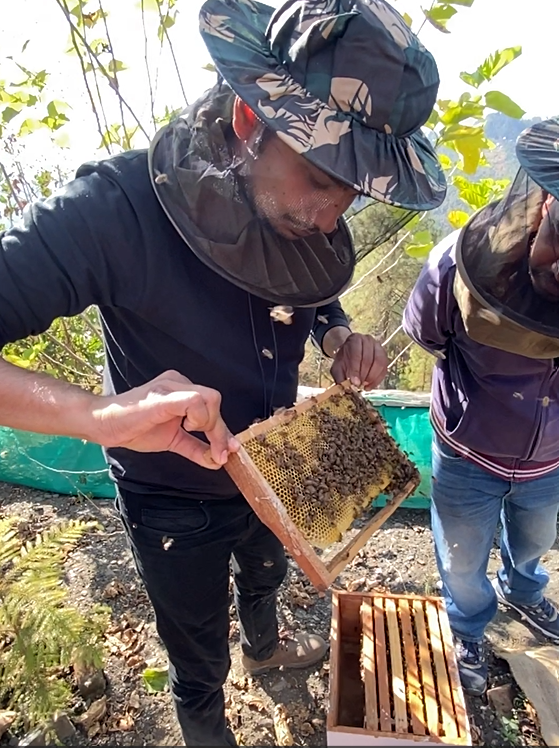
Wild bee colonies in the Kumaon forests of Uttarakhand — produce honey across rhododendron belts, wild thyme, alpine wildflowers, and ancient deodar and oak forests at 1,500 to 3,500 metres altitude. This honey is harvested only when the bees have fully sealed the honeycomb — the bees' own quality certification.
At the Kasar Devi facility in Almora, the honey is strained through muslin cloth to remove wax debris. No heat is applied to speed this process. Ambient mountain temperature only. The honey is then bottled at room temperature and sealed.
What reaches you is exactly what the bees made — in a specific season, from a specific landscape. It will crystallize in your jar. The aroma will be complex and change subtly between harvests. The colour will be dark amber. These are not defects. They are the natural consequences of honey that was never heated.
Shop Pahari Haat Himalayan Jungle Honey — ₹510, 250g →
Frequently Asked Questions
What does never heated honey mean?
Never heated honey means no heat was applied at any stage between hive and jar — during extraction, straining, storage, or bottling. It is a more specific claim than raw honey, which may still involve mild heating below pasteurization temperatures.
Is never heated honey the same as raw honey?
No. Raw honey means not pasteurized — which typically means not heated above 63°C. Never heated honey means zero heat at any stage. Many raw honey brands heat to 45 to 55°C for bottling efficiency. Never heated honey uses ambient temperature only throughout the entire process.
How do I know if my honey is truly never heated?
Crystallization is the most reliable indicator — genuinely never heated honey crystallizes naturally within weeks to months. Complex aroma, dark colour, and high diastase activity also confirm minimal processing. Ask the brand directly what temperature their honey is processed at.
Does never heated honey crystallize?
Yes — and this is proof of authenticity. Crystallization is caused by natural glucose precipitating out of solution. Heat prevents crystallization by dissolving crystals and removing pollen grains that trigger crystal formation. If your never heated honey crystallizes, it is behaving correctly.
What is the difference between never heated and cold pressed honey?
Cold pressed typically refers to extraction methods that avoid heat but may still involve mild warming. Never heated is absolute — zero heat, any temperature, at any stage. Never heated is the stronger claim.
Where can I buy genuinely never heated honey in India?
Pahari Haat Himalayan Jungle Honey is never heated at any stage — wild-harvested from Kumaon forests, Uttarakhand, strained through muslin cloth only, bottled at ambient temperature. Available at paharihaat.in for ₹510 for 250g with pan-India shipping.
More from Pahari Haat:
👉 Raw Honey vs Processed Honey — What's Actually Different →
👉 Best Honey in India 2026 — Complete Buyer's Guide →
👉 How to Test Honey Purity at Home →
👉 Himalayan Jungle Honey Benefits →
👉 Best Honey from Uttarakhand →
About Pahari Haat: Women-led Himalayan wellness brand. Kasar Devi, Almora, Uttarakhand. paharihaat.in. FSSAI certified.
This article is for general informational purposes. Not medical advice.