Two Years, Hundreds of Kilometers, and One Swollen Eye — The Story Behind Every Jar
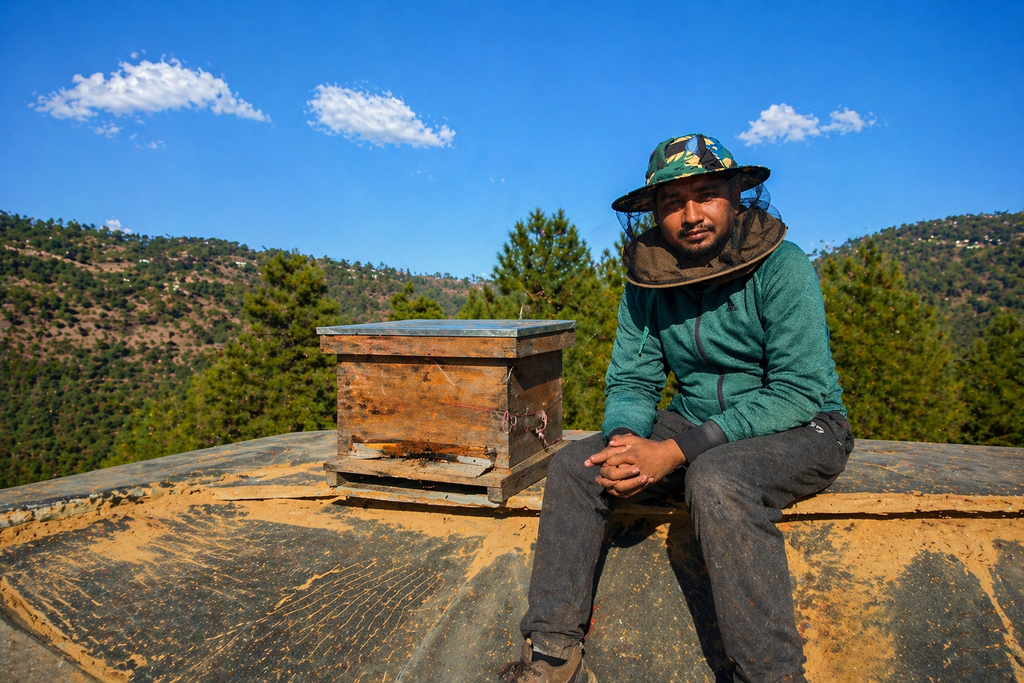
By Gaurav Agarwal, Founder, Pahari Haat — Kasar Devi, Almora, Uttarakhand
Published: April 2026
I did not set out to become a honey person.
Two years ago, I just wanted to find one jar of honey I could trust completely. One jar where I knew — not believed, not hoped — but actually knew that what was inside was exactly what it said on the label.
Simple enough, right?
It took me two full years, hundreds of kilometers across the Shivalik range, the foothills of Nainital, and deep into the Corbett jungle belt. It cost me more than I expected — in time, in money, and on one particularly memorable occasion, in my ability to see out of my left eye for three days.
But I found it. And this is that story.
Why Finding Good Honey Is Harder Than It Sounds
Most people think honey sourcing works like this: you find a beekeeper, they give you honey, done.
It does not work like that. Not if you want honey that is genuinely pure.
The challenge is not finding beekeepers — the Uttarakhand foothills have many. The Shivalik range, the Corbett belt, the areas around Nainital — there are beekeepers throughout. Some have been doing this for generations. Some started recently when they saw demand growing.
The real challenge is finding beekeepers whose practices match what genuine honey requires. And that — I discovered — is a much rarer thing.
Because here is what most people do not know: the way honey is harvested matters as much as where it comes from.
What I Was Looking For — and Why Most Beekeepers Said No
I had a simple list of requirements. Simple to state. Difficult to find.
No sugar feeding. When nectar is scarce — in lean flowering seasons — some beekeepers feed their bees sugar syrup to keep colonies strong. The bees process this syrup and store it alongside real honey. The result looks like honey. It tests like honey. But it is not honey — it is sugar syrup that bees have touched.
Only harvest sealed honey. This is the detail that most people — including many beekeepers — do not fully appreciate. When bees collect nectar, they store it in the honeycomb and begin the process of converting it into honey — removing moisture, adding enzymes, concentrating it. When the honey is ready, they seal the comb with beeswax. That seal is the bee's own quality certificate. Unsealed honey still has too much moisture — it ferments, it degrades. I wanted only fully sealed honey. Every single time.
Right season, right timing. Honey harvested outside the natural flowering season — when bees are storing reserves for lean periods — depletes the colony. I did not want to harvest what the bees needed for themselves. Only the surplus. Only at the right time.
No harm to the bees. This sounds obvious. It is not. Careless harvesting — taking too much, harvesting too often, disturbing colonies at the wrong time — weakens bee populations. I was not willing to build a honey brand on the back of damaged colonies.
When I explained this list to beekeepers — many of them experienced, many of them genuinely good at what they do — the most common response was a polite version of: this is going to make things complicated.
And they were right. It did.

Two Years on the Road
I spent the better part of two years visiting beekeepers across the Uttarakhand foothills — the Shivalik range, Corbett, the areas around Nainital. Some visits were planned. Many were not — someone would mention a beekeeper in a particular village and I would find myself driving there on a weekday morning to meet a person I had never spoken to.
The conversations were always the same at the start. Chai. Some background about what I was doing and why. Then the list.
Some beekeepers were immediately interested. Many were sceptical — not dishonestly, just practically. Sealed-only honey means smaller harvests. Right-season harvesting means fewer annual cycles. Not feeding sugar in lean periods means more careful colony management. Every one of these practices reduces yield. And for a beekeeper whose income depends on volume — these are not small sacrifices.
Convincing them required something beyond a conversation. It required a commitment — that I would pay them prices that made these practices financially worthwhile. That I would buy consistently, not just once. That I would be a partner in this, not just a buyer who disappears after the first batch.
That commitment is what eventually built the relationships that Pahari Haat is built on today.
The Day the Bees Disagreed With Me
I want to tell you that this journey was always poetic. Mountain air, golden honey, wise beekeepers sharing ancient knowledge under deodar trees.
Some of it was exactly like that.
Some of it was bees.
If you have never been stung by an angry hive — truly angry, not a single curious bee but a colony that has decided you are a threat — it is a particular kind of experience. You do not forget it.
I have been stung more times than I can count across these two years. A dozen times in a single afternoon on one occasion. On another — the one I remember most clearly — I took several stings near my eye. By the next morning, my left eye had swollen completely shut. For two days I could not see from that side.
My wife found this less amusing than I eventually did.
But here is the thing about those moments — and I mean this genuinely, not as a dramatic story flourish. When you have sat next to a hive that long, watched the bees work that closely, understood what they are actually doing — converting flower nectar into something extraordinary through weeks of careful, instinctive, biological effort — you develop a respect for the process that is very hard to describe.
You understand why it matters that this honey reaches people exactly as the bees made it. Without shortcuts. Without adulteration. Without processing that destroys what the bees spent all that time building.

What I Learned About Honey That Most People Never Know
Two years of standing next to hives teaches you things that no label, no marketing material, and no food safety certification can tell you.
Nectar is not honey — and the difference is everything. When a bee brings nectar back to the hive, it is approximately 70-80% water. Honey is typically 17-20% water. Getting from nectar to honey requires bees to fan the comb continuously — for days — to evaporate the moisture. They add enzymes. They move the nectar between cells. This is not a quick process. It cannot be rushed. When beekeepers harvest too early — before this process is complete, before the bees have sealed the comb — what comes out is immature honey. High moisture. Prone to fermentation. Nutritionally incomplete.
Completely sealed honey — the only kind I harvest — is the bee's own declaration that the process is done.
The super box matters more than most buyers know. In managed beekeeping, bees live in boxes. The lower section — the brood box — is where the queen lives, where eggs are laid, where the colony's core activity happens. The upper section — the super — is where bees store honey surplus beyond what they need.
The distinction that most people miss: during lean flowering periods, bees draw on their super stores for food. If a beekeeper harvests the super during this period — taking what the bees stored for themselves — the colony is weakened. Some beekeepers compensate by feeding sugar syrup. I do not harvest supers during lean periods. That honey belongs to the bees.
Ethical practice and good honey are not separable. This is the thing I most want people to understand. The practices that are good for the bees — unharvested lean-season stores, no sugar feeding, sealed-only harvest — are exactly the practices that produce the best honey. It is not a trade-off between ethics and quality. They are the same thing. Honey produced through ethical practice is better honey. Full stop.
The Foothills vs The High Mountains
People often ask me — why the foothills? Why not high Himalayan honey from 3,000 metres?
Honest answer: we work with both. I have beekeeper relationships in the hills — the Kumaon mountain zones — and in the foothills of the Shivalik range, the Corbett belt, around Nainital.
The high-mountain honey is extraordinary — bees foraging at altitude on wildflowers, rhododendron, alpine herbs. The botanical diversity is unmatched. But production is genuinely limited. The climate is harsher, flowering seasons are shorter, colony management is more difficult. What comes from these zones is exceptional — and there is not a lot of it.
The foothills — the Shivalik range, the Corbett jungle belt, the rich forest zones around Nainital — produce honey with a different but equally compelling character. The biodiversity here is extraordinary in its own right — dense sal forests, mixed jungle wildflowers, the unique flora of the Corbett ecosystem. Bees here forage across a rich and varied landscape that commercial agricultural-zone apiaries simply cannot replicate.
Both zones, when harvested with the practices I described — sealed only, right season, no sugar feeding, no harm — produce honey that I am proud to put my name on.

What a Perfect Jar of Honey Looks Like
After two years and everything I have described — the kilometers, the conversations, the training sessions with beekeepers, the stings, the swollen eye — when a batch of honey comes in that meets every standard:
Completely sealed at harvest. Right season. No sugar feeding. Never heated at any stage from hive to jar. Dark amber — the colour that tells you the bees have been foraging on botanically rich, diverse flora.
And then it crystallizes in the jar over the following weeks. That crystallization — which most people mistake for spoilage and which is actually the most reliable sign that honey is genuinely raw and unprocessed — is, to me, the final confirmation.
The bees did their job. The beekeeper did their job. I did my job. And what is in that jar is exactly what it should be.
I cannot fully explain the satisfaction of that moment. But I feel it every single time.
Why I Pay More Than the Market Rate
This is a business decision that some people find puzzling. I pay our beekeepers above market rate for their honey. Meaningfully above.
The reason is simple: the practices I am asking for reduce yield. Sealed-only harvesting means smaller batches. Right-season timing means fewer annual cycles. Not feeding sugar means more careful, more labor-intensive colony management.
If I asked for these practices and paid market rate — which is priced for conventional, higher-yield beekeeping — I would be asking beekeepers to do more work for the same money. That is not a partnership. That is exploitation.
Paying well for ethical practice is the only way to ensure those practices continue. If the economics do not work for the beekeeper, the practices disappear the moment I stop watching. That is not the foundation I want to build on.
When you buy a jar of Pahari Haat honey — you are not just buying honey. You are part of an arrangement where a beekeeper in the Uttarakhand foothills is being paid fairly to do things right. That matters to me. I hope it matters to you too.
From Their Hives to Your Home
Every jar of Pahari Haat Himalayan Jungle Honey follows the same path.
Wild bees foraging across the Shivalik range, the Corbett jungle belt, the foothills around Nainital — and in smaller quantities from the high Kumaon mountain zones. Harvested only when fully sealed. Only in the right season. Never from sugar-fed colonies. Never from depleted supers.
Brought to our facility in Kasar Devi, Almora. Never heated at any stage. Strained through muslin cloth only — to remove wax debris, nothing else. Poured into jars.
That is the entire process.
What you receive is what the bees made — with every enzyme, every pollen grain, every bioactive compound intact. It will be darker than supermarket honey. It will smell more complex. It will taste different between batches because the bees are real and forests are seasonal and nature does not do uniform.
And over weeks in your kitchen, it will crystallize. When it does — that is not a problem to fix. That is the proof you have been looking for.
Shop Pahari Haat Himalayan Jungle Honey →
One Last Thing
People sometimes ask me if all of this — the two years, the travel, the training, the stings — was worth it.
I think about a specific moment. Standing next to a hive in the Corbett foothills on a late afternoon. The beekeeper I had spent months convincing to change his harvesting timing — watching him carefully inspect a frame, put it back, and say: nahi, abhi nahi. Isko aur time chahiye. Not yet. This one needs more time.
He had understood. Not just the practice — the reason behind it. That what makes honey worth having is precisely what gets destroyed when you rush it.
That moment was worth every sting.
— Gaurav Agarwal, Founder, Pahari Haat
Kasar Devi, Almora, Uttarakhand
Want to know more about what makes raw honey genuinely different?
Raw Honey vs Processed Honey: What's Actually Different →
10 Science-Backed Benefits of Himalayan Jungle Honey →
7 Easy Home Tests to Check Your Honey is Real →
Best Honey in India 2026: Complete Buyer's Guide →
Why Uttarakhand Produces India's Best Honey →
About Pahari Haat: A women-led Himalayan wellness brand based in Kasar Devi, Almora, Uttarakhand — operating under Kartavya Karma Trust, Project Udyogini. Every product is sourced directly from Pahari farmers, artisans, and beekeepers. FSSAI certified.
Complete guide: Best Honey in India 2026 — Complete Buyer's Guide →