Nothing Goes to Waste: How Pahari Haat Turns Waste into Skills, Livelihoods and Lasting Change
From discarded beeswax and leftover Himalayan herbs to forgotten yarns and fabric scraps, Pahari Haat’s journey towards zero waste is not just about sustainability. It is about discovering hidden value, creating new skills and building dignified livelihoods for rural communities.
In the mountains, people have always understood the value of resources. Things are repaired before they are replaced, food is preserved for seasons when fresh produce is scarce, and materials often find a second or even a third life before they are finally discarded.
Yet, as markets expanded and production systems changed, waste slowly became a part of even small rural enterprises. At Pahari Haat, we were no exception.
For years, we worked closely with beekeepers, farmers, women artisans and small textile units across Uttarakhand. We bought honey, processed Himalayan herbs, created premium teas and worked with communities to develop handcrafted products. But somewhere along the journey, we began noticing something that we had previously overlooked.
After honey extraction, beeswax was being left unused.
After grading and sorting our herbal teas, broken flowers, leaves and aromatic herbs were being discarded.
Around Kasar Devi and Almora, leftover yarns and fabric scraps from textile units had nowhere to go.
At first, these seemed like three completely different problems.
Over time, however, we realised they were connected by one simple question:
What if the things we call waste are not actually useless? What if we simply haven’t discovered their next purpose yet?
That question gradually changed the way we looked at sustainability at Pahari Haat.
We stopped seeing waste merely as something that needed to be disposed of. We began seeing it as a resource waiting for an idea, a skill waiting to be taught and, perhaps, a livelihood waiting to be created.
This is how our journey from Waste to Wonder began.
It Started with Something We Never Thought Had Value
Our journey towards zero waste did not begin with a sustainability policy or a carefully planned environmental programme. It began with something far simpler: beeswax.
For years, many of the small beekeepers we worked with focused almost entirely on honey. Honey had a market, buyers understood its value, and selling it brought income to their families. Beeswax, on the other hand, was often treated as an unwanted by-product of honey extraction.
Many beekeepers had no reliable market for it. They did not know what products could be created from it, how it should be processed or where it could be sold. In many cases, beeswax was simply discarded, left unused or sold for a negligible amount.
When we understood this, we asked ourselves a simple question:
What if we started buying the beeswax too?
So, alongside honey, Pahari Haat began procuring beeswax from the beekeepers.
A material that had previously brought them little or no economic value suddenly became an additional source of income.
The beekeeper did not need another piece of land. He did not need to grow another crop or start an entirely new occupation. He did not need to invest in another business.
The resource was already there.
We simply had to recognise its value and create a market around it.
This small change had a meaningful impact. Beekeepers who previously earned only from honey could now earn from beeswax as well. The same beehive, the same season and the same hard work could create more economic value for the beekeeper and his family.
But buying beeswax solved only one part of the problem.
The next question was even more important:
What could we create from it, and could that creation generate opportunities for someone else?
The answer took us to rural women who were already making candles.
From Low-Cost Paraffin Candles to a New Craft
Some of the women we came across already knew how to make conventional paraffin candles. They had the basic skills, they knew the process, and they were willing to work.
But there was a problem.
Paraffin candles are mass-produced and widely available at very low prices. Because the final product itself has limited market value, the women making these candles also receive very little money for their labour.
No matter how hard they worked, there was only so much income that a low-value product could generate.
We began wondering whether the same women could use their existing experience to learn a more specialised craft.
That was when Pahari Haat started training women to make pure beeswax candles.
Working with natural beeswax was different. It required patience, practice and an understanding of the material. The women learned how to clean and filter the wax, work with the right temperatures, use moulds, create hand-rolled candles and maintain the quality expected from a premium handcrafted product.
It was not simply a change in raw material.
It was an upgrade in skill.
Over time, women who had once made inexpensive paraffin candles began creating a completely different product: natural, handcrafted beeswax candles with a higher value in the market.
And suddenly, one small idea began creating impact at several levels.
The beekeeper earned additional income from beeswax that had previously gone unused.
A natural resource found a new purpose instead of becoming waste.
Rural women learned a specialised craft.
Their work could command better value because they were now creating a premium product.
And customers received a natural alternative to conventional paraffin candles.
One resource. Two livelihoods. And almost nothing wasted.
This experience taught us something that would later influence many of our decisions at Pahari Haat.
Sustainability creates its greatest impact when it does not stop at saving resources, but goes further to create economic opportunities for people.

Then We Discovered That We Were Creating Waste Too
It is always easy to notice what someone else is doing wrong.
It is much harder to look at your own processes with the same honesty.
At Pahari Haat, we work extensively with Himalayan herbs and flowers. Chamomile, lavender, rose petals, spearmint, mugwort and several other aromatic herbs pass through our hands before becoming part of our teas and herbal products.
Our teas are carefully sorted and graded. This process is important because we want the final product reaching our customers to maintain a certain quality.
But grading and sorting inevitably leave something behind.
Broken flowers. Smaller petals. Leaves. Stems. Herbal fragments and other materials that may not meet the visual standards required for our premium teas.
For a long time, we did what many businesses do.
We threw it away.
At that time, we did not think much about it. The best-quality herbs went into our products, while the remaining material was considered waste.
But as our understanding of sustainability evolved, something began to bother us.
These herbs had been grown by farmers.
They had required land, water, labour and time.
Someone had harvested them.
Someone had dried them.
Someone had transported them.
And after all that effort, were we really going to decide that a broken flower or a smaller leaf had no value simply because it could not go into a premium tea packet?
We realised that perhaps the problem was not with the herbs.
The problem was with our imagination.
We had not yet discovered what else they could become.
When Herbal Tea Waste Became the Beginning of Something New
The more we looked at our herbal waste, the more obvious the opportunity became.
Lavender was still aromatic.
Rose petals still carried their natural fragrance.
Chamomile, spearmint, mugwort and other herbs had not suddenly become useless simply because they did not pass a grading process.
So, once again, we asked the same question:
What else can this become?
That question led us towards incense making.
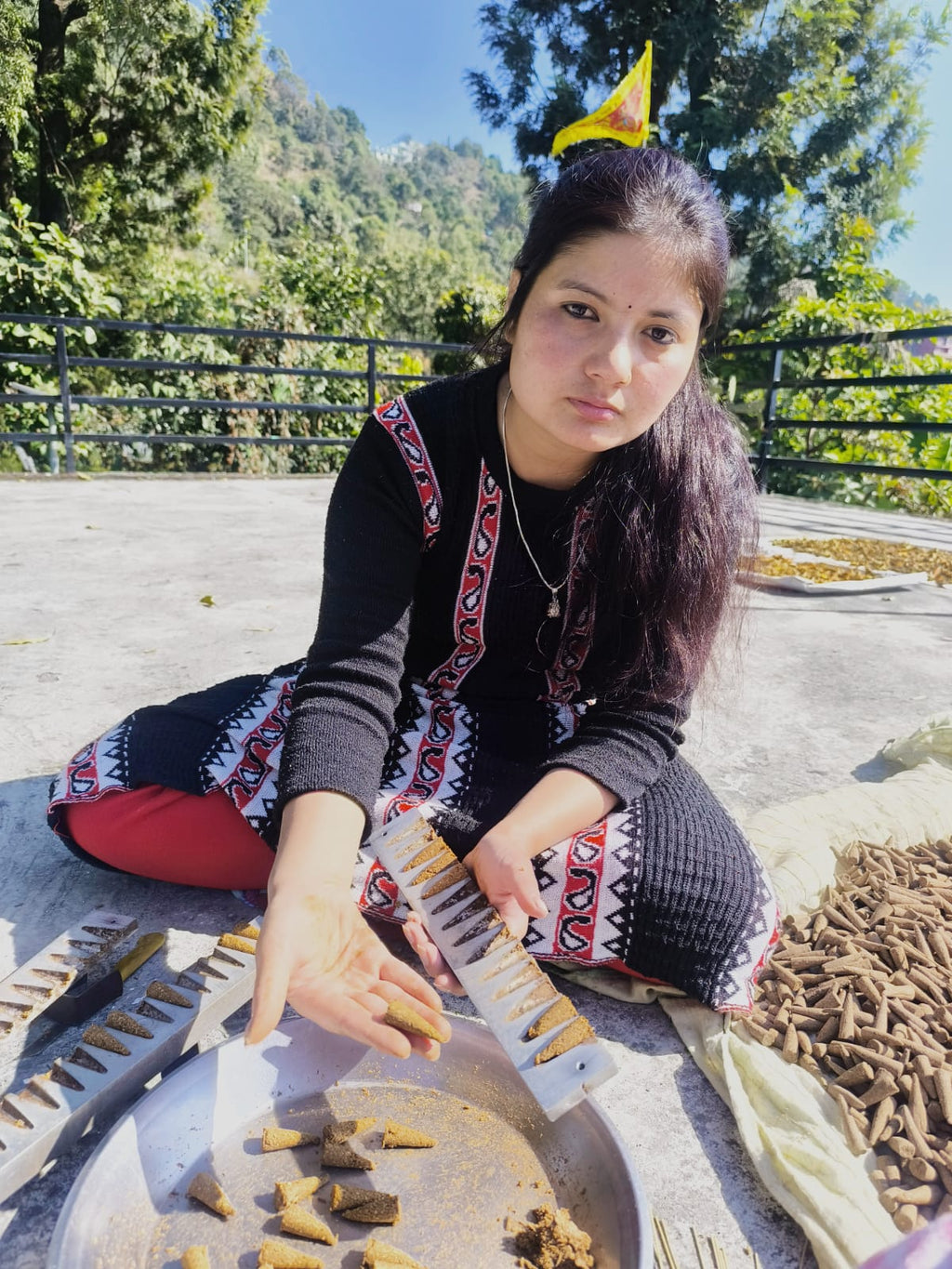
We began exploring whether the aromatic herbs left behind after grading and sorting could be transformed into handcrafted incense sticks and cones.
The idea made sense environmentally.
But for us, that was not enough.
We did not want to simply create another product in a factory. We wanted to see whether this new idea could also create another skill and another livelihood opportunity in the villages.
So, we began training rural women in incense making.
The women learned how to work with different herbs, how ingredients could be processed and blended, how incense sticks were rolled, how cones were shaped and how drying, consistency and quality affected the final product.
For many of these women, this was an entirely new craft.
Slowly, something that had previously gone into our waste began taking a completely different form.
Herbal incense sticks.
Handcrafted incense cones.
Natural aromatic products made from materials that had once been discarded.
Once again, the impact went far beyond waste management.
Pahari Haat found a productive use for herbal waste.
A group of rural women learned a new skill.
The skill created work.
The work created income.
And the income created another opportunity for women to become more economically independent.
Think about the journey of a single chamomile flower.
A farmer grows it in the Himalayas. The flower is harvested, carefully dried and brought for processing. The best flowers are sorted and packed into our premium herbal teas. The smaller and broken parts that once had no purpose are now given another life as handcrafted incense.
A woman artisan uses her newly acquired skills to transform that material into a product.
The product eventually finds its way into someone’s home.
The flower was not wasted.
The farmer’s effort was not wasted.
The resource was not wasted.
And somewhere along the journey, a woman gained a new skill and another opportunity to earn.
That, for us, is what a circular economy should look like at the grassroots level.
Then We Began Looking at the Waste Around Us
Our experience with beeswax and herbal waste had already changed the way we looked at resources.
We had learned to ask one question repeatedly:
What else can this become?
That question eventually led us to the textile waste generated around Kasar Devi and Almora.
The region is home to artisans, designers, small businesses and organisations working with textiles. Beautiful fabrics are woven, garments are stitched and handcrafted products are created.
But every textile activity leaves something behind.
Small pieces of fabric.
Leftover yarn.
Threads.
Cuttings.
Materials too small to be used in conventional production.
For larger textile units, these materials often have little commercial value. They accumulate over time, remain unused or eventually become waste.
But by now, our team had learned not to look at waste as the end of a process.
We began looking at the piles of leftover yarn and fabric and asking ourselves what possibilities were hidden inside them.
Could leftover fabric become jewellery?
Could discarded yarn become Rakhis?
Could forgotten threads become wall hangings, home décor or creative crafts?
Once again, the answer was not simply about developing products.
The answer was about developing people and skills around those products.
From Forgotten Threads to Creative Livelihoods
The Pahari Haat team began experimenting with different ways of using leftover fabric and yarn.
Fabric scraps were transformed into handmade jewellery.
Leftover yarn was used to create Rakhis.
Threads and other materials became wall hangings, decorative products and creative crafts.
But an idea only creates impact when people have the skills to bring it to life.
So, women were trained.
They learned new techniques.
They experimented with materials they had never worked with before.
They learned how colours could be combined, how products could be finished, how designs could be improved and how something considered worthless could be transformed into something beautiful.
A piece of discarded fabric became jewellery.
A bundle of leftover yarn became a handcrafted Rakhi.
Forgotten threads became home décor.
Waste management happened naturally, but something much more important was happening alongside it.
Women were learning. Women were creating. Women were earning.
Once again, we saw the same cycle taking shape.
Waste became a resource.
A resource created the need for a skill.
Training created that skill.
The skill created a product.
The product created an income.
And income created new possibilities.
The Real Story Was Never Just About Waste
It would be easy to describe all of this as Pahari Haat’s zero-waste initiative.
Beeswax becomes candles.
Herbal tea waste becomes incense.
Textile waste becomes crafts.
But if we tell the story only this way, we miss the most important part of it.
Because the real transformation was never happening only to the materials.
It was happening to people.
Every time we found a new purpose for a discarded resource, we also found an opportunity to teach someone a new skill.
And every time a woman learned a new skill, something began to change.
At first, perhaps, it was simply the ability to make a candle, roll an incense stick or create jewellery from leftover fabric.
Then that skill became work.
Work became income.
Income created confidence.
And confidence slowly began changing the way women saw themselves and the way their families and communities saw them.
For many rural women, earning an income is about much more than money.
It can mean contributing to household expenses.
It can mean being able to spend on a child’s education.
It can mean not having to depend on someone else for every small personal need.
It can mean having a greater say in family decisions.
It can mean confidence.
It can mean dignity.
And gradually, it can mean becoming a decision-maker.
This is the social change that numbers and sustainability reports often fail to capture.
A woman does not become empowered simply because she attends a training programme.
Real change begins when the skill she learns becomes useful.
When that skill creates work.
When work generates income.
And when income gives her greater control over the decisions that shape her life.
That is why, at Pahari Haat, we have come to believe that skill development should never end with a training certificate.
A skill must find a market. A product must find a customer. And a woman’s work must receive the value it deserves.
Only then does training become livelihood.
And only then does livelihood begin creating lasting social change.
Waste. Skill. Creation. Livelihood.
Over time, we began noticing a pattern in everything we were doing.
Beeswax had little value until someone recognised its potential.
Herbal residue was waste until someone imagined incense.
Textile scraps were useless until someone saw jewellery, Rakhis and crafts hidden inside them.
But there was another pattern too.
Every new use for waste created the possibility of a new skill.
And every new skill created the possibility of a new livelihood.
That is how we began understanding our own circular model:
Waste → Skill → Creation → Livelihood
Waste becomes a resource.
Training transforms that resource into a skill.
Skills create products.
Products create livelihoods.
Livelihoods create confidence.
Confidence creates greater independence.
And independent women help create stronger families and stronger communities.
The cycle does not end with a product being sold.
In many ways, that is where the real impact begins.
We Are Still Learning What Zero Waste Really Means
We would love to say that we understood all of this from the beginning.
We did not.
There was a time when we threw away our herbal tea waste because we simply did not know what else to do with it.
There was a time when beeswax was an overlooked by-product in the supply chain we worked with.
There was a time when leftover fabrics and yarns around us were simply someone else’s waste.
We learned gradually.
We experimented.
We made mistakes.
And with every mistake, we began looking at our work differently.
That is why zero waste, for us, is not a claim of perfection.
It is a commitment to keep learning.
To become more conscious about the resources we use.
To question the processes we have always taken for granted.
To find better uses for what remains.
And, most importantly, to ask whether every environmental solution can also create a human opportunity.
Can this waste become a resource?
Can this resource become a product?
Can creating that product teach someone a skill?
Can that skill create a dignified livelihood?
Whenever the answer is yes, we know we have found something worth pursuing.
When You See a Product, We See the Journey Behind It
When you look at a Pahari Haat beeswax candle, you may simply see a candle.
We see the beekeeper who earned additional income from a material that once had little value.
We see the woman who learned to work with natural beeswax.
We see hours of training, mistakes, practice and improvement.
We see a new skill.
We see better work.
We see dignity in earning.
When you look at our handcrafted herbal incense, you may simply see an aromatic product.
We see flowers and herbs that received a second life.
We see resources that did not go to waste.
We see a woman learning how to make incense for the first time.
We see another skill becoming another source of livelihood.
When you see jewellery, Rakhis or crafts created from leftover textiles, you may simply see a beautiful handmade product.
We see forgotten pieces of fabric.
We see discarded yarn.
We see creativity.
We see hands learning something new.
We see women earning.
We see change.
Perhaps that is the difference between simply making products and trying to create impact.
Nothing Is Wasted When We Learn to See Possibilities
Today, Pahari Haat’s journey towards zero waste is still evolving.
There are more materials we need to rethink.
More processes we need to improve.
More mistakes we will probably make.
More ideas we need to experiment with.
More skills we hope to teach.
And many more livelihoods we hope to create.
But the journey so far has taught us something that will remain at the heart of everything we do.
Value does not disappear simply because we fail to recognise it.
Sometimes, value is hidden inside beeswax left behind after honey extraction.
Sometimes, it is hidden inside broken chamomile flowers, rose petals and aromatic herbs.
Sometimes, it is hidden inside a forgotten bundle of yarn or a discarded piece of fabric.
And sometimes, the greatest potential is hidden in the hands of a woman who has simply never been given the opportunity to discover what she is capable of creating.
At Pahari Haat, we are trying to bring these possibilities together.
To create a market for what was once discarded.
To create products from what was once considered waste.
To create skills where opportunities were limited.
And to create livelihoods that can gradually lead to confidence, independence and meaningful social change.
We know that one beeswax candle will not change the world.
One incense cone will not solve the problem of waste.
One handcrafted product will not transform an entire community.
But when a beekeeper earns more because his beeswax has found a market, something changes.
When a woman learns a new skill and earns with dignity, something changes.
When waste becomes a resource instead of reaching a dumping ground, something changes.
And when thousands of such small changes begin coming together, they create something far more powerful than a product.
They create possibilities.
That is what zero waste means to us.
Not simply using less.
Not simply throwing away less.
But learning to see more.
More value in our resources.
More possibilities in our waste.
More potential in people.
And more opportunities to create a future where sustainability and livelihoods do not exist separately, but strengthen each other.
At Pahari Haat, our journey began with a simple question:
What else can this become?
Today, that question continues to guide us.
From honey to beeswax candles.
From herbal tea waste to handcrafted incense.
From textile scraps to creative crafts.
From training to skills.
From skills to livelihoods.
From livelihoods to confidence.
And from confidence to change.
Nothing goes to waste when every resource is given another chance, and every person is given an opportunity to grow.
This is our journey from Waste to Wonder. This is how we are trying, one resource and one livelihood at a time, to create a more sustainable Himalaya.
FAQ
What is Pahari Haat’s Waste to Wonder initiative?
Pahari Haat’s Waste to Wonder initiative focuses on finding new uses for materials that would otherwise be discarded. Beeswax left after honey extraction is transformed into natural candles, herbal waste from tea grading and sorting is used to make incense sticks and cones, and leftover fabric and yarn are upcycled into creative crafts. These activities also help rural women learn new skills and create sustainable livelihood opportunities.
How does Pahari Haat use beeswax left after honey extraction?
Pahari Haat procures beeswax alongside honey from beekeepers and uses it to create handcrafted natural beeswax candles. This gives beekeepers an additional source of income while providing rural women with opportunities to learn specialised candle-making skills and earn through the production of higher-value handcrafted products.
How is herbal tea waste transformed into incense?
During the grading and sorting of premium herbal teas, smaller petals, broken flowers, leaves and other aromatic herbal materials may be left behind. Pahari Haat works to utilise materials such as lavender, rose petals, chamomile, spearmint and mugwort by transforming them into handcrafted incense sticks and cones with the involvement of trained women artisans.
How does Pahari Haat use textile waste?
Pahari Haat works with leftover fabrics, yarns, threads and other textile materials to create products such as fabric jewellery, handcrafted Rakhis, wall hangings and creative crafts. This approach helps utilise materials that might otherwise remain unused while creating new skill-development and livelihood opportunities for rural women.
How does the Waste to Wonder initiative support rural women?
The initiative provides women with training in skills such as beeswax candle making, herbal incense making and textile upcycling. These skills can lead to meaningful work, additional sources of income, greater confidence and increased participation in household and financial decision-making.
What is Pahari Haat’s approach to zero waste?
For Pahari Haat, zero waste is an evolving journey rather than a claim of perfection. The approach focuses on identifying value in discarded resources, finding creative ways to reuse materials, developing new products and connecting sustainability with skill development and livelihood generation.
-
Posted in
Beeswax Candles, Circular Economy, Eco Friendly Products, Herbal Incense, Himalayan Communities, Pahari Haat, Rural Entrepreneurship, Rural Women, Skill Development, Social Impact, Sustainability, Sustainable Livelihoods, Sustainable Products, Textile Waste, Upcycling, Uttarakhand, Waste to Wonder, Women Artisans, Women Empowerment, Zero Waste