Sustainable Gifting in India: A Complete Guide to Eco-Friendly, Artisanal & Conscious Gifts
There was a time when choosing a gift was simple.
A box of sweets for Diwali. Dry fruits for important clients. A decorative item for a wedding. Branded merchandise for employees.
The bigger the box looked, the more generous the gift seemed.
But gifting in India is changing.
Today, people are beginning to look beyond what is inside the box. They want to know where a product came from, who made it, what materials were used, whether the packaging was necessary, and whether their purchase created meaningful value beyond the moment of unboxing.
This shift is giving rise to sustainable gifting in India — a more thoughtful approach to giving that brings together environmental responsibility, craftsmanship, conscious consumption and social impact.
It is changing corporate gifting too. Businesses searching for sustainable corporate gifts, eco-friendly corporate gifts, meaningful Diwali hampers and artisanal gifts are increasingly looking beyond generic merchandise towards gifts with provenance, purpose and a story worth telling.
Perhaps that is the most important change of all.
A gift does not have to be bigger to be better.
It simply has to mean more.
Quick Answer: What Is Sustainable Gifting in India?
Sustainable gifting in India is the practice of choosing meaningful gifts that are thoughtfully sourced, responsibly made, useful and designed to create less waste while supporting people and communities. It includes eco-friendly gifts, artisanal and handmade products, conscious gifting, zero-waste gifts and sustainable corporate hampers.
The best sustainable gifts create value at three levels — for the recipient, for the maker and for the planet — turning every gift into an opportunity to celebrate while creating positive impact.
What Is Sustainable Gifting?
Sustainable gifting is about looking beyond the gift itself and considering its entire journey — how it was sourced, who made it, how it was packaged, whether it will actually be used and what impact it leaves behind.
It may mean choosing something handmade instead of mass-produced. It may mean supporting a local artisan instead of an anonymous supply chain, selecting a useful or consumable product instead of something destined for a cupboard, or choosing thoughtful packaging without unnecessary layers of plastic and decoration.
But sustainable gifting goes much deeper than replacing plastic with kraft paper.
A product wrapped in an earthy-looking box is not automatically sustainable.
The real questions begin before the packaging.
Where did the raw materials come from? Who made the product? Were local livelihoods or traditional skills involved? Will the recipient genuinely use it? Could waste have been reduced? And what happens when the product has served its purpose?
These questions separate genuinely thoughtful gifting from sustainability used merely as a marketing label.
At its best, sustainable gifting creates value at three interconnected levels.
Recipient. Maker. Planet.
The recipient should receive something meaningful and useful. The maker should receive meaningful economic value from creating it. And its impact on the planet should be considered from sourcing to afterlife.
This Recipient–Maker–Planet principle offers a simple way to understand what truly sustainable gifting should aspire to be.
India Has Been Gifting Sustainably for Generations — We Just Never Called It That
The idea of sustainable gifting may sound modern, but its roots in India are old.
Long before terms such as eco-friendly, zero waste and conscious consumption became popular, Indian households gifted things made close to home.
Handwoven textiles travelled between families. Local sweets were prepared and packed for festivals. Pottery, spices, handmade baskets, regional foods and traditional crafts were exchanged during weddings and celebrations.
Gifts often came from a known place and, sometimes, from a known maker.
India’s craft traditions were built around natural materials and skills passed from one generation to another — handloom weaving, pottery, woodcraft, metalwork, embroidery, folk art, handmade paper and countless regional food traditions.
Modern consumption changed much of this.
Mass production made gifting faster and more standardised. Corporate gifting turned into catalogues filled with identical merchandise. Festive hampers became larger, shinier and more elaborate.
Somewhere along the way, packaging often became more important than provenance.
Now, that thinking is beginning to change.
The growing interest in sustainable gifts in India, handmade gifts, artisanal gifting, ethical gifting and conscious living gifts is not simply another lifestyle trend.
In many ways, it is a rediscovery of something India has always understood:
Things made with care carry a different kind of value.
Sustainable, Eco-Friendly, Ethical and Conscious Gifting: What Is the Difference?
These terms frequently appear together, but they do not mean exactly the same thing.
An eco-friendly gift primarily focuses on reducing environmental impact. It may use natural, recycled, reusable, biodegradable or responsibly chosen materials while avoiding unnecessary packaging.
Sustainable gifting takes a broader view. It considers materials and packaging, but also sourcing, production, livelihoods, usefulness, longevity and what happens to a product after use.
Ethical gifting brings people into the conversation. It asks who made the product, under what conditions it was produced and whether the purchase creates fair and meaningful value for the people behind it.
And then there is conscious gifting.
Conscious gifting begins before the product is even selected.
It asks a simple but powerful question:
Why am I giving this?
A conscious gift is chosen intentionally rather than purchased simply because an occasion demands something.
The strongest gifts often exist at the intersection of all these ideas.
They are environmentally thoughtful, ethically produced, genuinely useful and consciously chosen.
The Rise of Artisanal Gifting in India
There is something fundamentally different about receiving an object made by human hands.
A machine is designed to make every object identical.
An artisan leaves behind traces of individuality.
A slight variation in a handwoven textile, a brushstroke in traditional art, the texture of handmade paper or the form of a hand-poured candle reminds us that someone — not simply something — made it.
That human connection is one reason artisanal gifting in India is becoming increasingly relevant.
But artisanal gifting is about much more than aesthetics.
Across India, thousands of traditional skills depend on viable markets to survive. Younger generations are less likely to continue a craft when craftsmanship cannot provide a reliable livelihood.
Every time a traditional craft disappears, we lose more than a product.
We lose knowledge.
This makes gifts supporting artisans particularly meaningful.
A gift can become a small economic bridge between an urban consumer and a rural craftsperson, between a modern company and a traditional skill, or between a celebration and someone’s livelihood.
This becomes even more powerful when rural women artisans are part of that value chain.
For many women in rural communities, livelihood opportunities that can be carried out within or close to their villages can provide income while allowing them to remain connected to their families and communities.
A handmade gift can therefore carry an invisible story.
Behind it may be income, skill, dignity, confidence and the continuation of a craft.
That is what can turn an ordinary product into a social-impact gift.
What the Himalayas Can Teach Us About Sustainable Gifting
To understand what sustainable gifting can look like beyond labels and packaging, travel — at least in imagination — to a Himalayan village.
The landscape changes first.
Terraced farms replace city roads. Forests climb mountain slopes. Herbs grow in small fields. Bees move between flowers and orchards. Traditional skills coexist with agricultural rhythms shaped by altitude, weather and season.
In places like Uttarakhand, sustainability is not always an abstract environmental philosophy.
For mountain communities, resources have historically been valuable precisely because they are limited.
Things are reused. Materials find second lives. Seasonal produce is preserved. Skills pass between generations.
This philosophy sits at the heart of the gifting ecosystem being developed by Pahari Haat, rooted in the Himalayas and connected with farmers, rural women and artisans.
Instead of asking only:
What products can we put inside a hamper?
A more meaningful question is:
How many meaningful stories can one gift connect?
The answer can begin with something as simple as a bee.
From Honey to Beeswax: When One Gift Creates Another
A jar of Himalayan honey may appear to be the finished product.
But nature rarely works in straight lines.
Beekeeping gives us honey, but the same ecosystem also gives us beeswax.
That wax has value.
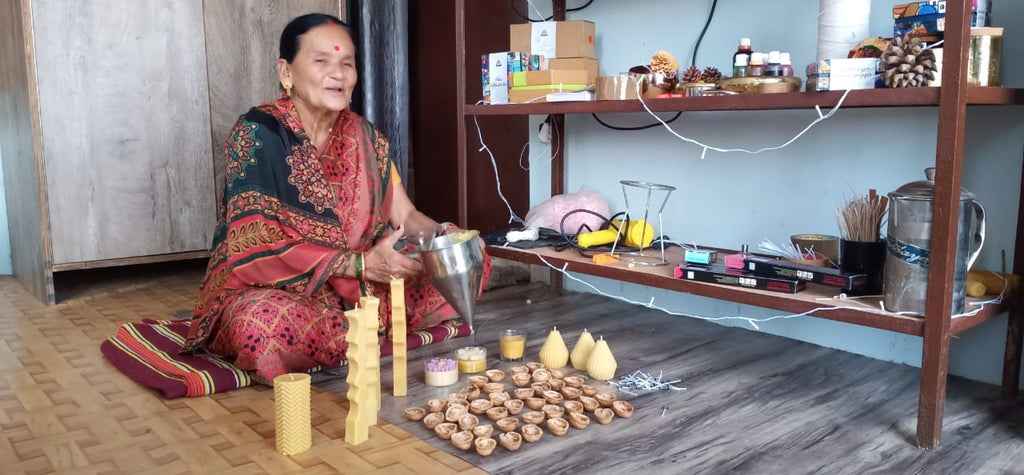
It can be cleaned, prepared and transformed into handcrafted pure beeswax candles, giving the material another purpose while creating another opportunity for skilled work.
Follow the chain.
A beekeeper tends to the bees. Honey becomes a natural food product. Beeswax becomes a valuable raw material. Candle making can create additional livelihood opportunities for artisans and rural women. A thoughtfully curated gift hamper can create demand for both.
One ecosystem has now created multiple layers of value.
This is the difference between thinking about sustainability as a single product and understanding sustainability as a connected system.
It also reveals one of the most powerful ideas behind sustainable gifting:
Nothing valuable should automatically become waste simply because its first purpose is complete.
When “Waste” Becomes the Beginning of Another Product
The same thinking can extend across a rural production ecosystem.
Consider herbal teas.
Flowers, herbs and leaves are harvested, dried, sorted and graded. The finest material may become part of a tea blend, while smaller botanical fragments can remain after processing.
A conventional linear system may simply see leftover material as waste.
A circular system asks a different question:
Can suitable material have another useful life?
Botanical by-products may inspire incense or other value-added applications where appropriate. Textile remnants from craft production can sometimes become smaller accessories or creative products. Agricultural by-products may find entirely new purposes.
This is where zero-waste gifting becomes far more meaningful than simply putting a recyclable label on a box.
True waste-conscious thinking begins with design.
It asks how materials can remain valuable for longer.
The philosophy can be expressed simply:
From resource to product. From by-product to possibility. From possibility to livelihood.
That is the spirit of circular gifting.
The Best Sustainable Gifts Are Gifts People Actually Want
There is an uncomfortable truth that sustainable gifting sometimes overlooks:
A sustainable gift that nobody wants can still become waste.
Good intentions cannot replace good gifting.
The recipient should genuinely want to use, consume or cherish what they receive.
That is why some of the best sustainable gift ideas in India combine responsible choices with usefulness, sensory experience and emotional value.
A thoughtfully curated Himalayan gift hamper, for example, might bring together herbal teas, Himalayan honey, handcrafted beeswax candles, regional spices, traditional salts, natural incense or artisan-made products.
Each has a life beyond the box.
Tea becomes a morning or evening ritual. Honey reaches the breakfast table. A candle creates warmth during a quiet evening. Spices enter the kitchen. An artisan-made object remains part of a home.
The sustainability lies not only in how something was made.
It also lies in the fact that it is genuinely used and valued.
This is why consumable, reusable and long-lasting products can make some of the most meaningful sustainable gifts.
Himalayan Wellness Gift Hampers: Gifting an Experience, Not Just Products
Wellness has become one of the strongest themes in modern gifting, but the best wellness gift hampers go beyond putting several fashionable products into an attractive box.
A meaningful wellness hamper should create an experience.
Imagine opening a gift and finding fragrant chamomile and lavender flowers for an evening infusion, Himalayan honey for a slow breakfast, a handcrafted beeswax candle for quiet evenings and botanical incense that gently transforms the atmosphere of a room.
These products may be different, but together they tell one story:
Slow down.
That is what makes conscious living gifts so relevant today.
They encourage rituals rather than clutter.
Tea asks you to sit for a few minutes.
A candle changes the mood of a room.
A handmade object asks to be noticed rather than consumed quickly.
A regional ingredient creates curiosity about the landscape and people it came from.
In a world built around speed, perhaps slowness itself has become a form of luxury.
And this is where Himalayan gift hampers can offer something different — not merely a collection of products, but an experience rooted in wellness, provenance, craftsmanship and place.
Sustainable Corporate Gifting in India: From Merchandise to Meaning
Nowhere is the opportunity for sustainable gifting greater than in the corporate world.
Consider the scale.
An individual might purchase five or ten gifts during a festival.
A company may purchase five hundred, five thousand or even more.
At that scale, a purchasing decision becomes an economic force.
This is why sustainable corporate gifting in India deserves to be seen as more than a festive procurement trend.
Imagine two companies working with a similar gifting budget.
One purchases generic merchandise that recipients may or may not use.
The other chooses thoughtfully curated products connected with farmer groups, rural enterprises, artisans, small producers and women-led livelihood initiatives.
The expenditure may be similar.
The impact can be very different.
Corporate gifting can create demand across entire livelihood chains.
This is where sustainability, responsible procurement, employee engagement and social impact can meet something surprisingly simple:
A gift.
The most powerful corporate gifts tell stories that employees and clients actually want to remember.
A candle may carry the story of rural craftsmanship.
A jar of honey may connect back to Himalayan beekeeping.
A handmade product may help preserve a traditional skill.
A curated hamper may bring together the work of farmers, artisans and rural women in a single gifting experience.
Suddenly, the gift becomes a conversation.
And conversations are remembered longer than merchandise.
Sustainable Corporate Diwali Gifts: Rethinking India’s Biggest Gifting Season
Every year, as Diwali approaches, thousands of businesses face the same question:
What should we gift this year?
The usual answers are familiar — sweets, dry fruits, chocolates, electronics and branded merchandise.
There is nothing inherently wrong with these gifts.
But companies now have an opportunity to make their Diwali gifting more distinctive and meaningful.
Sustainable corporate Diwali gifts can bring together celebration, craftsmanship, wellness and social impact.
Think about the symbolism of Diwali itself.
Light, renewal, community, prosperity and gratitude.
A handcrafted beeswax candle has a natural connection with the festival of light.
Pair it thoughtfully with Himalayan honey, herbal tea, artisanal foods, traditional crafts or handmade products, and a conventional corporate hamper can become something much more memorable.
A well-designed sustainable Diwali gift hamper does not need ten forgettable fillers to look valuable.
It might contain fewer, better products — each useful, thoughtfully sourced and connected by one coherent story.
This distinction matters.
Sustainable luxury is not about giving less value. It is about removing what has no value.
Corporate customisation can still be elegant and premium through thoughtfully designed sleeves, personalised message cards, branded inserts and curated combinations.
The key is balance.
Branding should complement the gift rather than overwhelm it.
The recipient should first experience the craftsmanship.
Then discover the story.
And then remember who sent it.
Corporate Gifts for Employees and Clients Should Not Be Identical
One common mistake in corporate gifting is treating every recipient as if they are the same.
Employee gifting and client gifting often serve different purposes.
For employees, a gift may communicate appreciation, belonging and wellbeing. Sustainable employee gifts therefore work particularly well when they feel useful and personal — wellness hampers, artisanal teas, honey, handcrafted lifestyle products and regional food experiences.
Client gifting may require a different level of curation and presentation.
Premium artisanal gift hampers, Himalayan wellness collections, regional gourmet gifts and luxury sustainable gifts can create a distinctive experience without depending on excessive packaging or predictable luxury merchandise.
For leadership teams, important clients and special occasions, provenance itself can become a form of luxury.
A rare regional ingredient.
A traditional craft.
Something made in limited batches.
An object shaped by human hands.
A story that cannot be mass-manufactured.
The future of luxury gifting may not be defined only by how expensive something looks, but by how difficult its story is to replicate.
What Does Zero-Waste Gifting Really Mean?
“Zero waste” is one of the most frequently used phrases in sustainability.
Absolute zero waste, however, can be difficult to achieve.
A more responsible approach is to focus on waste reduction, thoughtful consumption and circular design rather than making exaggerated claims.
A waste-conscious gift may prioritise products that are consumable, reusable, refillable, recyclable, upcycled or designed for long-term use.
Packaging matters too, but it should not become sustainability theatre.
Replacing a plastic ribbon while retaining five unnecessary layers of packaging does not solve much.
A better question is:
Does this layer need to exist at all?
This is particularly important for sustainable gift hampers.
Premium presentation does not require excess.
Thoughtful design can make paper, natural textures, reusable containers and minimal materials feel sophisticated and luxurious.
Sustainability and beauty are not opposites.
Often, restraint is what makes design feel truly premium.
Sustainable Wedding Gifts: Celebrating Without Unnecessary Waste
Indian weddings create another enormous opportunity for conscious gifting.
Hundreds — sometimes thousands — of wedding favours may be distributed during a single celebration.
At that scale, small choices multiply quickly.
Couples exploring sustainable wedding gifts in India can consider artisanal teas, miniature honey jars, handcrafted candles, traditional crafts, regional foods, useful keepsakes and thoughtfully curated wellness gifts.
The philosophy remains simple:
Give fewer things. Choose better things. Tell their story.
A wedding favour connected to a craft, village, landscape or regional tradition can become far more memorable than an anonymous decorative object.
And when hundreds of guests receive such gifts, one purchasing decision can create meaningful demand for artisans and small producers.
How to Choose a Truly Sustainable Gifting Brand in India
As sustainability becomes popular, almost anything can be marketed as “green”, “natural” or “eco-friendly”.
So how do you identify the best sustainable gifting brands in India?
Do not begin with the colour of the packaging.
Begin with the story behind the product.
Where does it come from?
Who made it?
Can the brand explain its sourcing?
Does sustainability exist in the product and business model, or only in the marketing language surrounding it?
Look for transparency around materials, makers, communities, production and packaging.
For corporate gifting, practical capability matters too. A good gifting partner should be able to discuss customisation, realistic lead times, bulk quantities, shipping requirements, packaging options and the stories behind the products without relying on exaggerated impact claims.
Most importantly, look for specificity.
“Supporting artisans” sounds good.
Which artisans?
“Supporting farmers” sounds good.
Where?
“Eco-friendly” sounds good.
How?
The more specific and transparent the answer, the more meaningful the claim.
A Simple Framework for Choosing a Sustainable Gift
Before choosing your next gift, remember three words:
Recipient. Maker. Planet.
Recipient: Will this person genuinely value, use or enjoy what I am giving?
Maker: Does this purchase create meaningful value for the people who grew, crafted or produced it?
Planet: Have materials, packaging, waste, usefulness and longevity been considered thoughtfully?
No gift will be perfect on every measure.
Sustainability is rarely about perfection.
It is about making progressively better choices.
If a gift creates joy for the recipient, meaningful value for the maker and less unnecessary burden on the planet, it is moving in the right direction.
From the Himalayas to a Gift Box: Why Pahari Haat Exists
Pahari Haat was built around a simple idea:
What if products from Himalayan communities could reach modern markets without losing the stories of the people and places behind them?
The answer can be found in many interconnected stories.
In herbal teas connected to mountain agriculture.
In Himalayan honey linked with beekeeping.
In beeswax finding another purpose through handcrafted candles.
In traditional foods and ingredients carrying the flavours and knowledge of Uttarakhand.
In crafts that create opportunities for rural women and artisans.
And in gift hampers that bring these seemingly separate worlds together.
For an individual, this can mean choosing a gift with greater meaning.
For a company ordering hundreds or thousands of gifts, the potential becomes much larger.
One thoughtfully planned corporate order can create demand across multiple rural value chains.
One Diwali hamper can connect a corporate desk in Delhi, Mumbai, Bengaluru or another city with a beekeeper, farmer or artisan working in the Himalayas.
That distance may be geographical.
The gift becomes the bridge.
The Future of Gifting in India Will Not Be About Bigger Boxes
For years, gifting has often been designed around abundance.
More products.
More layers.
More decoration.
More volume.
But perhaps the future looks different.
Perhaps luxury will mean knowing exactly where something came from.
Perhaps premium will mean something made slowly and thoughtfully.
Perhaps corporate gifting will increasingly become a form of responsible procurement.
Perhaps Diwali hampers can create livelihoods rather than simply creating more packaging waste.
And perhaps the most valuable thing inside a gift box will not always be a product.
It will be a story.
A story about a farmer who grew something.
A beekeeper who cared for a colony.
A woman who transformed a skill into a livelihood.
An artisan who kept a tradition alive.
A material that found another purpose instead of becoming waste.
And a recipient who now understands where their gift came from.
That is the possibility behind sustainable gifting in India.
Not perfect gifting.
Not performative sustainability.
Just better choices, made more consciously.
Because a truly meaningful gift should leave something valuable behind:
Joy for the person who receives it.
Opportunity for the person who made it.
And as little unnecessary burden as possible for the planet we all share.
That is more than sustainable gifting.
That is gifting with purpose.
Frequently Asked Questions About Sustainable Gifting in India
What is sustainable gifting?
Sustainable gifting means choosing gifts while considering their environmental and social impact, including sourcing, materials, production, packaging, usefulness, longevity and the livelihoods connected with their creation.
What are the best sustainable gifts in India?
Some of the best sustainable gifts include handmade artisan products, herbal teas, responsibly sourced honey, natural candles, regional foods, reusable products, wellness hampers and meaningful gifts that support local producers and traditional crafts.
What is the difference between sustainable and eco-friendly gifts?
Eco-friendly gifts primarily focus on reducing environmental impact, while sustainable gifting takes a broader view that may include responsible sourcing, livelihoods, production practices, usefulness, packaging and long-term impact.
What is conscious gifting?
Conscious gifting means choosing a gift intentionally by considering whether the recipient will value it, who made it, where it came from and what environmental or social impact the purchase may create.
What is artisanal gifting?
Artisanal gifting focuses on products created using specialised craftsmanship, often handmade or produced in small batches by artisans, traditional craftspeople, rural producers and independent makers.
What are good sustainable corporate gifts?
Artisanal hampers, Himalayan wellness gift boxes, herbal tea collections, honey, handcrafted candles, handmade products and regional gourmet gifts can be meaningful choices for sustainable corporate gifting.
What are good sustainable corporate Diwali gifts?
Sustainable corporate Diwali gifts can include handcrafted beeswax candles, Himalayan wellness hampers, artisanal teas, honey, regional foods and handmade products presented in thoughtful, lower-waste packaging.
What are zero-waste gifts?
Zero-waste or waste-conscious gifting aims to minimise unnecessary waste by prioritising reusable, consumable, recyclable, upcycled or long-lasting products while reducing excessive packaging.
How can corporate gifting support artisans and rural women?
Companies purchasing artisan-made and community-produced gifts at scale can create market demand and livelihood opportunities for craftspeople, farmers, rural enterprises and women-led production groups.
Are sustainable gifts suitable for premium and luxury gifting?
Yes. Luxury sustainable gifting can focus on exceptional craftsmanship, provenance, rare regional products, thoughtful curation, personalization and premium presentation without relying on unnecessary excess.
What are Himalayan gift hampers?
Himalayan gift hampers bring together products connected with mountain regions and communities, such as herbal teas, honey, traditional foods, wellness products, handcrafted candles and artisan-made creations.
How do I choose a sustainable gifting brand in India?
Look for transparent and specific information about sourcing, materials, makers, production, packaging and impact. A credible sustainable gifting brand should be able to explain not only what it sells, but where its products come from, who helps create them and what makes its approach more responsible.
-
Posted in
Artisanal Gifting, Artisanal Gifts India, Best Sustainable Gifting Brands in India, Conscious Gifting, Conscious Living Gifts, Corporate Diwali Gifts, Corporate Gift Hampers India, Eco Conscious Gifts, Eco-Friendly Corporate Gifts, Eco-Friendly Gifts India, Ethical Corporate Gifting, Ethical Gifting, Gifts from Uttarakhand, Gifts Supporting Artisans, Handmade Gifts India, Himalayan Gift Hampers, Himalayan Gifts, holistic-living, Luxury Sustainable Gifts, Mindful Gifting, Pahari Haat, Purpose Driven Gifts, Responsible Gifting India, Social Impact Gifts, Sustainable Client Gifts, Sustainable Corporate Diwali Gifts, Sustainable Corporate Gifting, Sustainable Diwali Gifts, Sustainable Employee Gifts, Sustainable Festive Gifts, Sustainable Gift Hampers, Sustainable Gifting in India, Sustainable Gifts India, Sustainable Wedding Gifts, Wellness Gift Hampers, Women Artisan Gifts, Zero Waste Corporate Gifts, Zero Waste Gifts