Eco-Friendly Gifts in India: Gifts With a Story Before They Reach the Box
What if a gift had a story long before it became a gift?
Before the ribbon.
Before the box.
Before the handwritten note.
Imagine a jar of Himalayan honey sitting beside a collection of herbal teas.
Follow the story backwards and you find bees, flowers, mountain landscapes, herbs and people whose work connects nature with the final product.
Now follow another path.
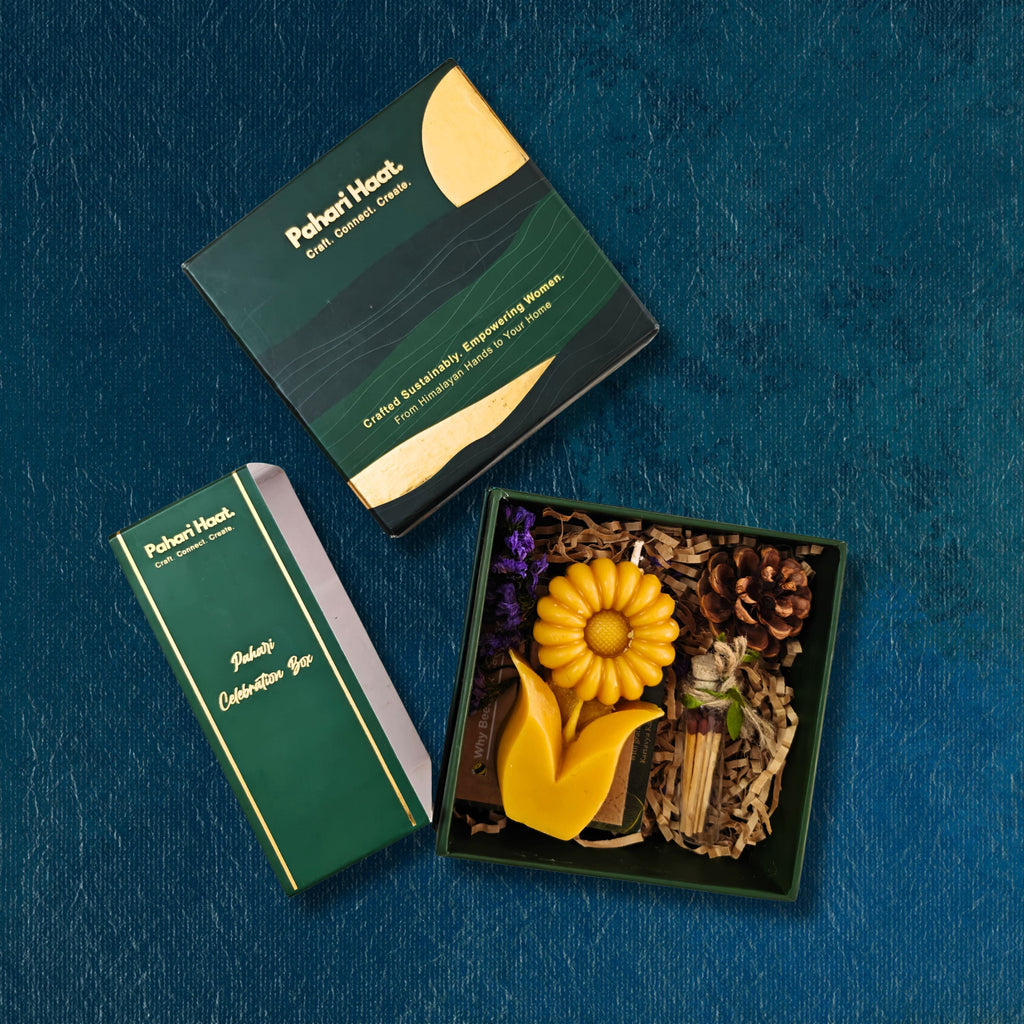
Beeswax associated with the beekeeping ecosystem becomes a material in the hands of a maker. It is transformed into handcrafted, unscented, non-toxic and smokeless beeswax candles, packed into gift boxes designed to bring natural warmth into someone’s home.
Elsewhere, a plain diary becomes a canvas.
An artisan paints traditional Aipan art across its surface by hand. The same artistic tradition travels onto pen stands, envelopes, bookmarks, postcards and other stationery.
Another diary takes an entirely different journey.
Needle.
Thread.
Hours of patient work.
Hand embroidery transforms an everyday object into a piece of functional craftsmanship.
And then there is perhaps the most unexpected story of all.
Material left behind during herbal tea processing — something that might otherwise be treated simply as waste — finds another purpose.
It becomes incense cones.
Different products.
Different skills.
Different journeys.
But one idea connects them all:
A meaningful gift should carry more than what fits inside its box.
That is where the real story of eco-friendly gifts in India begins.
Quick Answer: What Are the Best Eco-Friendly Gifts in India?
The best eco-friendly gifts in India are useful, thoughtfully made gifts that minimise unnecessary waste while creating meaningful value for the people who make and receive them. Strong options include Honey-Tea Gift Hampers, handcrafted beeswax candles, hand-painted Aipan stationery, hand-embroidered diaries, upcycled incense, artisan-made products and thoughtfully curated sustainable gift hampers.
The simplest way to judge an eco-friendly gift is to ask:
Will it be used? Who made it? What story does it carry? And what happens to its materials after use or production?
The strongest gifts have meaningful answers to all four.
The Greenest-Looking Gift Is Not Always the Most Eco-Friendly
We have developed a visual stereotype of sustainability.
Kraft paper.
Jute rope.
Brown cardboard.
A tiny green leaf printed somewhere.
Perhaps the words Earth Friendly written in a handwritten font.
But sustainability is not a colour palette.
A gift can arrive in brown paper and still contain five things nobody needs.
A bamboo product can still become clutter.
A giant “eco hamper” can still contain excessive packaging.
And something handmade is not automatically environmentally responsible simply because it was made by hand.
The real question is not:
Does this gift look eco-friendly?
It is:
What happened because this gift was made?
That question takes us much deeper.
It connects eco-friendly gifting with the larger philosophy of sustainable gifting in India, where we consider not only materials and packaging but also usefulness, sourcing, craftsmanship, livelihoods and waste.
To understand that difference, forget the catalogue for a moment.
Follow the products instead.
Story One: A Gift That Begins With Honey and Tea
Some gifts do not need complicated explanations.
Tea and honey already belong together.
One creates a ritual.
The other finds its way naturally into breakfasts, beverages and kitchens.
That simplicity is precisely what makes a Honey-Tea Gift Hamper such a strong example of conscious gifting.
At Pahari Haat, a Honey-Tea Gift Hamper can bring together honey with different varieties of herbal teas, creating a gifting experience built around taste, aroma, wellness and everyday rituals.
The recipient does not have to figure out what to do with the gift.
The tea gets brewed.
The honey gets opened.
The products become part of life.
That matters.
Because one of the most overlooked principles of eco-friendly gifting is remarkably simple:
A gift that gets used is usually better than a gift that merely gets stored.
Now imagine opening a hamper containing different teas.
One might be floral.
Another refreshing.
Another designed for a slow evening ritual.
The recipient begins exploring them one cup at a time.
The gift is no longer a single moment of unboxing.
It becomes twenty, thirty or perhaps more small experiences.
This is where consumable gifting has an advantage.
The product fulfils its purpose.
It creates enjoyment.
And then it is gone.
No permanent clutter required.
But the story of this hamper becomes even more interesting when we follow what happens elsewhere in the same ecosystem.
Because honey is not the only material associated with bees.
Story Two: When Beeswax Becomes Light
Imagine receiving a box of candles.
You open it expecting fragrance.
There is none.
That is intentional.
These are pure beeswax candles — unscented, non-toxic and smokeless — handcrafted and presented in gift boxes.
Their appeal comes not from synthetic fragrance or elaborate decoration, but from the material itself and the craftsmanship that transforms it.
Beeswax creates a fascinating connection between nature, beekeeping and gifting.
The story begins in the same broader world as honey, but takes a completely different direction.
Honey becomes something we consume.
Beeswax becomes something a maker can shape.
Roll.
Pour.
Mould.
Transform.
Eventually, it becomes light.
There is something particularly appropriate about gifting candles in India.
They belong naturally in homes.
They create atmosphere.
They connect beautifully with celebrations, housewarmings, weddings and especially Diwali.
But the deeper idea is more interesting.
One ecosystem can create more than one form of value.
Honey can become part of a Honey-Tea Gift Hamper.
Beeswax can become a handcrafted candle.
The gift changes.
The material changes.
The maker may change.
But value continues travelling.
This is what sustainable design looks like when it stops being an abstract concept.
You can hold it.
You can light it.
Story Three: The Tea Is Packed. But Something Is Left Behind.
Now return to the herbal tea.
Flowers, herbs and leaves must be processed, sorted and prepared before they reach a tea pouch.
Not every piece of botanical material becomes part of the final tea.
So what happens to what remains?
In a conventional linear system, the answer is often simple:
Waste.
But someone can ask a different question.
Can we make something from this?
This question led to one of the most interesting products in Pahari Haat’s gifting ecosystem:
Incense cones made from waste generated through herbal tea processing.
Think about that journey.
Botanical material begins as part of the herbal tea ecosystem.
The suitable material is selected for tea.
Instead of seeing every remaining usable by-product simply as something to discard, it can be explored for another purpose.
It becomes incense.
The material has moved from one sensory experience to another.
From taste and aroma in a cup...
to fragrance and atmosphere in a room.
This is a much more interesting interpretation of zero-waste gifting than simply putting a gift inside recyclable packaging.
Because real waste reduction begins before packaging.
It begins with a question:
What are we throwing away, and does it still have value?
That question is going to become increasingly important as consumers explore more thoughtful approaches to eco-friendly and zero-waste gifts.
Not everything can be reused.
Not every production process can become waste-free.
Claims should never be exaggerated.
But whenever something considered waste can responsibly become a useful product, we move one step closer to a more circular way of making things.
And perhaps the most memorable sustainable products are those that make us look at waste differently.
Story Four: When a Diary Becomes a Canvas for Aipan
Now the story leaves farms, herbs and beekeeping.
It enters the world of art.
Take an ordinary diary.
Its function is simple.
You write in it.
Now place that diary in the hands of an Aipan artist.
Something changes.
Lines begin to appear.
Patterns.
Geometry.
Traditional motifs.
The surface is painted by hand.
The diary still functions as a diary.
But now it carries something else:
culture.
Aipan is a traditional folk art associated with Uttarakhand, recognised through distinctive motifs and patterns traditionally created for auspicious, cultural and ceremonial contexts.
When this artistic vocabulary travels onto contemporary products, tradition enters everyday life in a new form.
At Pahari Haat, handmade and hand-painted Aipan stationery can include diaries, pen stands, envelopes, bookmarks, postcards and other hand-painted objects.
These products make particularly interesting artisanal gifts because they bring together two qualities that gifting often struggles to combine:
usefulness and uniqueness.
A bookmark has a purpose.
A pen stand has a purpose.
A diary has a purpose.
An envelope has a purpose.
But hand-painted art gives each object individuality.
No mass-printed pattern can carry quite the same relationship with the person who painted it.
Look closely and you may find tiny variations.
One line differs slightly from another.
A motif carries the rhythm of the hand that created it.
In industrial manufacturing, inconsistency is often treated as a defect.
In handmade art, variation can be evidence.
Evidence that someone was there.
That is why the deeper world of artisanal gifting deserves its own conversation.
Because when we choose handmade products, we are not simply choosing an object.
We are choosing to keep human skill inside the economy.
Story Five: The Diary That Cannot Be Made in Five Minutes
There is another diary.
But this one tells a completely different story.
There is no quick print.
No machine applying an identical decorative pattern to thousands of units.
There is needlework.
Thread.
Concentration.
Repetition.
Time.
A hand-embroidered diary turns something familiar into a showcase of skill.
You can buy countless diaries.
That is exactly what makes this one interesting.
Its value does not come from the fact that diaries are rare.
Its value comes from the fact that the work on it is difficult to reproduce without the skill and time of a human being.
This distinction may define the future of handmade luxury.
For decades, luxury often meant expensive materials and famous labels.
But in a world capable of manufacturing millions of identical products, another form of luxury is emerging:
Time.
Something took hours to make.
Someone learned how to do it.
Someone’s hands were involved.
No two pieces feel completely identical.
That is difficult to mass-produce.
A hand-embroidered diary can therefore be much more than stationery.
It becomes functional art.
Something to use.
Something to keep.
Something that can start a conversation.
And that is exactly what a memorable gift should do.
Five Gifts. Five Different Meanings of “Eco-Friendly.”
Now place these products beside each other.
A Honey-Tea Gift Hamper.
A box of handcrafted beeswax candles.
Hand-painted Aipan stationery.
A hand-embroidered diary.
Incense cones created using herbal tea processing waste.
They are not environmentally responsible for exactly the same reason.
And that is important.
There is no single formula for an eco-friendly gift.
The Honey-Tea Gift Hamper represents usefulness, consumability and a connection with natural and Himalayan products.
The beeswax candles show how a natural material can be transformed through craftsmanship into a useful gift.
The tea-waste incense cones demonstrate circular thinking and the possibility of finding value in a production by-product.
The Aipan stationery connects functional products with traditional art and human skill.
The hand-embroidered diaries celebrate slow craftsmanship, time and individuality.
Together, they reveal something bigger:
Eco-friendly gifting is not a product category. It is a way of thinking about value.
The Gift Box Test: Remove Everything That Does Not Deserve to Be There
Now comes the difficult part.
Packaging.
Corporate gifting and festive hampers often suffer from what we might call the Big Box Problem.
A large box looks expensive.
So brands feel pressure to fill it.
A little tea.
A tiny jar.
Some decorative grass.
A miniature spoon.
A filler product.
Another filler product.
A tray to hold the fillers.
A sleeve around the tray.
A ribbon around the sleeve.
Soon, half the gifting experience exists simply to make the box look fuller.
This is where eco-friendly gifting needs discipline.
Try the Gift Box Test:
Open the hamper mentally and remove one product.
Does the gift become worse?
No?
Remove it.
Now remove a packaging layer.
Does the gift still remain protected and beautiful?
Yes?
Remove it.
Repeat.
What remains should earn its place.
This does not mean sustainable gifts should look plain.
Presentation matters enormously.
Opening a gift should feel special.
But good design and excess are not the same thing.
A smaller box with three extraordinary products can feel far more luxurious than an enormous hamper filled with twelve forgettable ones.
Luxury is not how much space a gift occupies.
Luxury is how much value remains after the box is opened.
Why “Useful” May Be the Most Powerful Sustainability Word in Gifting
Imagine receiving a beautiful decorative object.
You appreciate it.
Then you wonder where to put it.
Now imagine receiving tea you will drink, honey you will eat, a diary you will write in, a bookmark you will use, candles you will light or incense you will burn.
There is an obvious difference.
The second group already has a future.
This is why usefulness should sit at the centre of eco-friendly gifting.
We often discuss materials first.
Bamboo versus plastic.
Paper versus acrylic.
Recycled versus virgin material.
These comparisons matter.
But before all of them comes a more fundamental question:
Will anybody use this?
An unused “sustainable” product still required resources to exist.
That is why some of the strongest conscious gifts are products that naturally enter daily life.
Food.
Tea.
Honey.
Stationery.
Candles.
Craft with function.
Consumable products.
Useful handmade objects.
The most environmentally intelligent gift may sometimes be the least complicated one.
When 5,000 Gifts Are Ordered, One Choice Becomes an Economy
Now multiply everything.
One Honey-Tea Hamper becomes 5,000.
One handcrafted candle box becomes 5,000.
One artisan-made diary becomes hundreds.
Suddenly, gifting changes scale.
This is where sustainable corporate gifting in India becomes especially powerful.
A corporate buyer is not simply choosing products.
They are choosing where demand flows.
Large orders can create work across sourcing, making, finishing, packing and fulfilment.
For artisanal products, this can be particularly meaningful because craftsmanship depends on markets.
A craft does not survive because people admire photographs of it.
It survives because someone values it enough to buy it.
This is why companies should look beyond one question:
What is the price per box?
And ask another:
What does this order make possible?
The answer may include work for artisans.
Demand for handmade products.
Opportunities for rural women.
Markets for Himalayan products.
A second life for materials that might otherwise become waste.
At scale, purchasing becomes impact.
Diwali: What If the Festival of Light Actually Gifted Light?
There is a beautiful simplicity to this idea.
Diwali.
A festival of light.
A box of handcrafted beeswax candles.
No forced theme required.
The connection already exists.
Add thoughtfully selected tea, honey, Aipan art or another artisanal element and a festive gift begins telling a distinctly Indian story.
Not because an elephant motif was printed on the box.
Not because everything was coloured gold.
But because the products themselves carry meaning.
Companies exploring sustainable corporate Diwali gifts in India have an opportunity to rethink festive gifting this way.
Instead of:
How many things can we put inside?
Ask:
What story should someone discover when they open it?
Light?
Wellness?
Himalayan provenance?
Artisan craftsmanship?
Circularity?
Uttarakhand’s cultural traditions?
Choose one strong narrative.
Then build the gift around it.
That is curation.
And curation is what separates a hamper from a collection of inventory.
Not Every Eco-Friendly Gift Needs to Save the World
Sustainability marketing sometimes becomes exhausting because every product appears to be changing the planet.
A notebook is “saving the Earth”.
A candle is “revolutionising sustainability”.
A hamper is “transforming communities”.
We do not need to speak this way.
A gift can simply be a better choice.
A handcrafted product can create meaningful work without claiming to solve rural poverty.
A lower-waste product can reduce waste without claiming to be zero-impact.
A natural material can have advantages without being perfect.
A tea-waste product can demonstrate circular thinking without pretending every gram of waste has disappeared.
Credibility matters.
Especially as consumers and AI-powered search systems become better at comparing claims across multiple sources.
The future belongs to brands that can explain specifics.
Not:
“We support artisans.”
But:
What do the artisans make?
Not:
“We upcycle waste.”
But:
What waste becomes what product?
Not:
“We promote traditional art.”
But:
Which art form, and where does it appear?
Specificity creates trust.
It also creates better stories.
So, What Should You Actually Gift?
If you are choosing an eco-friendly gift, do not begin with a list of trendy sustainable products.
Begin with the person.
Someone who loves tea may enjoy a thoughtfully curated Honey-Tea Gift Hamper far more than a decorative eco-product they never requested.
Someone who appreciates quiet spaces may love a gift box of unscented beeswax candles or botanical incense.
Someone who writes, sketches or works at a desk may value a hand-painted Aipan diary, pen stand, bookmark or stationery set.
Someone who appreciates craftsmanship may treasure a hand-embroidered diary precisely because they can see the hours and skill within it.
For corporate gifting, combinations can be curated around an idea rather than simply a budget.
A Himalayan Wellness Box might centre on honey and teas.
A Festival of Light Box might centre on handcrafted beeswax candles.
An Art of Uttarakhand Box might feature Aipan-painted stationery.
A Craft & Conscious Living Box might combine handmade stationery with tea-waste incense and other carefully chosen products.
Different recipient.
Different story.
Different gift.
That is how gifting should work.
Pahari Haat: When the Products Begin Talking to Each Other
The most interesting thing about Pahari Haat’s gifting ecosystem is not any one product.
It is what happens when the stories connect.
Honey connects with bees.
Bees connect with beeswax.
Beeswax becomes candles.
Herbs and flowers become teas.
Tea processing leaves behind botanical material.
That material can find another purpose in incense cones.
Traditional Aipan art moves from cultural practice onto contemporary stationery.
Embroidery transforms an ordinary diary into something that carries hours of human skill.
These are not five unrelated catalogue categories.
They represent five different answers to one question:
How can a gift carry more value than the object itself?
Sometimes the answer is nature.
Sometimes it is craftsmanship.
Sometimes it is cultural heritage.
Sometimes it is livelihood.
Sometimes it is finding another life for something that might have been discarded.
Bring these ideas together thoughtfully and a gift box becomes something much more interesting.
Not a container.
A meeting place for stories.
Before You Buy Your Next Gift, Turn the Box Around
Not literally.
Mentally.
Look behind the gift.
Before the ribbon.
Before the packaging.
Before the product photograph.
Ask:
Where did this begin?
Who touched it?
Who made it?
Will the recipient use it?
What happened to the materials that were left behind?
Could fewer things have created a better gift?
These questions will not always produce perfect answers.
That is fine.
Sustainability is not a competition for purity.
It is the practice of making better choices with better information.
And perhaps that is the future of eco-friendly gifting in India.
Not endless lists of bamboo products.
Not brown packaging pretending to be a philosophy.
Not guilt wrapped in recycled paper.
But gifts that are genuinely worth giving.
A jar of honey that carries a landscape.
Tea that becomes a ritual.
Beeswax transformed into light.
Waste transformed into incense.
A diary transformed by embroidery.
A blank surface transformed by Aipan art.
And ordinary objects transformed by one thing mass production can never fully replicate:
A meaningful story.
Frequently Asked Questions About Eco-Friendly Gifts in India
What are eco-friendly gifts?
Eco-friendly gifts are thoughtfully chosen products that aim to reduce unnecessary environmental impact through factors such as usefulness, responsible materials, lower-waste design, reusability, consumability or circular use of resources. A genuinely eco-friendly gift should also be something the recipient is likely to use or value.
What are the best eco-friendly gifts in India?
Meaningful options include Honey-Tea Gift Hampers, handcrafted beeswax candles, handmade stationery, artisan-painted products, hand-embroidered diaries, upcycled products, wellness gifts and other useful gifts made with thoughtful sourcing and lower-waste principles.
What are some unique artisanal gift ideas from India?
Unique artisanal gifts can include hand-painted Aipan diaries and stationery, handcrafted candles, hand-embroidered diaries, traditional craft products, artisan-made home accessories and gift hampers combining handmade products with regional foods or wellness products.
What is Aipan art gifting?
Aipan art gifting uses Uttarakhand’s traditional Aipan artistic motifs on giftable products such as hand-painted diaries, pen stands, envelopes, bookmarks, postcards and other stationery or decorative objects, bringing traditional art into contemporary gifting.
Are beeswax candles good for gifting?
Beeswax candles can make distinctive natural and artisanal gifts. Pahari Haat’s handcrafted beeswax candle gift boxes feature unscented, non-toxic and smokeless candles and can be used for festive, wellness, housewarming and corporate gifting.
What are upcycled gifts?
Upcycled gifts are products that creatively use materials or by-products that might otherwise have lower value or become waste. One example from Pahari Haat’s ecosystem is incense cones made using waste generated through herbal tea processing.
What are good eco-friendly corporate gifts?
Honey-Tea Gift Hampers, handcrafted beeswax candle boxes, Aipan art stationery, hand-embroidered diaries, artisan-made gifts and thoughtfully curated wellness hampers can provide distinctive eco-conscious corporate gifting options.
What are good sustainable Diwali gift ideas?
Handcrafted beeswax candles, Honey-Tea Gift Hampers, Aipan art products, artisan stationery, wellness hampers and thoughtfully curated handmade gifts can work particularly well for sustainable Diwali gifting.
Are handmade gifts always sustainable?
Not necessarily. Handmade production alone does not automatically make a product sustainable. Materials, usefulness, sourcing, production methods, durability, packaging and waste should also be considered.
How do I choose an eco-friendly gift?
Start with the recipient rather than the sustainability label. Choose something they will genuinely use or value, then consider how it was made, who made it, what materials were used, how it is packaged and what happens to it after use.
How can eco-friendly gifting support artisans?
Choosing high-quality artisan-made products creates market demand for craftsmanship. When purchases are made consistently and at scale, particularly through corporate gifting, they can help create economic opportunities for artisans and rural makers.
What makes Pahari Haat’s gifting approach different?
Pahari Haat brings together multiple Himalayan and artisanal gifting stories, including Honey-Tea Gift Hampers, handcrafted beeswax candles, hand-painted Aipan stationery, hand-embroidered diaries and incense cones made using herbal tea processing waste. The focus is on connecting useful gifts with craftsmanship, cultural heritage, circular thinking and meaningful stories.
-
Posted in
Aipan Art Gifts, Aipan Stationery, Artisanal Gifts India, Beeswax Candle Gifts, Conscious Gifting, Eco-Friendly Corporate Gifts, Eco-Friendly Diwali Gifts, Eco-Friendly Gift Ideas, Eco-Friendly Gifts in India, Eco-Friendly Gifts India, Ethical Gifting, Gifts Supporting Artisans, Hand Embroidered Diaries, Hand Painted Gifts, Handmade Gifts India, Handmade Stationery Gifts, Himalayan Gift Hampers, Himalayan Gifts, Honey Tea Gift Hamper, Pahari Haat, Social Impact Gifts, Sustainable Corporate Gifts, Sustainable Diwali Gifts, Sustainable Gift Hampers, Sustainable Gift Ideas, Sustainable Gifts India, Tea Waste Incense, Upcycled Gifts India, Women Artisan Gifts, Zero Waste Gifts India