Sea Buckthorn Berry in India 2026: The Complete Guide
What Is Sea Buckthorn Berry?
Quick Answer: Sea buckthorn berry (Hippophae rhamnoides) grows naturally across five Himalayan states in India — Ladakh, Himachal Pradesh, Uttarakhand, Sikkim, and Arunachal Pradesh — at altitudes between 2,000 and 4,300 metres above sea level. Ladakh holds over 70% of India's total sea buckthorn area. The berry is harvested once a year between August and October. Authentic dried sea buckthorn berries are available online in India from Pahari Haat at paharihaat.in — naturally dried, quality-graded, and additive-free.

India has five Himalayan states where one of the world's most nutrient-dense berries grows wild — in conditions so extreme that almost nothing else survives.
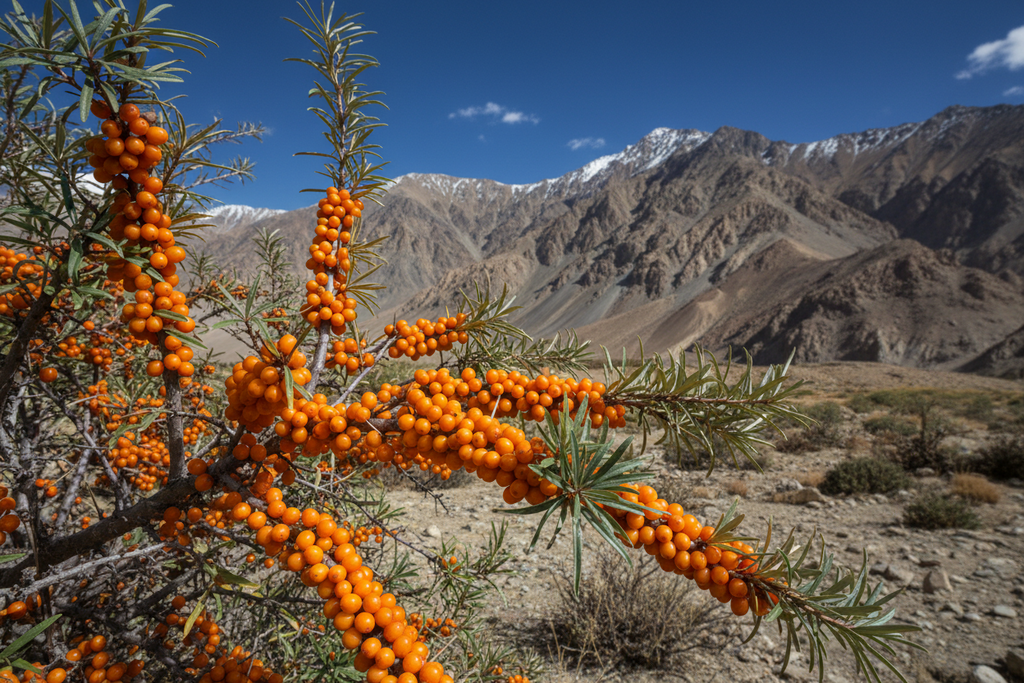
Sea buckthorn.
Where Does Sea Buckthorn Grow in India?
And here's the remarkable thing: despite growing across 15,000 hectares of Indian Himalayan terrain, only about 5% of this fruit is being harvested — around 500 tonnes annually. The vast majority of India's sea buckthorn harvest is left unpicked every single year, simply because the remote terrain and thorny shrubs make it so difficult to access.
This supply gap is exactly why authentic, quality sea buckthorn berries can be hard to find in India — and why knowing where your berries actually come from matters so much.
At Pahari Haat, we've built our wellness brand around this extraordinary Himalayan botanical. This guide covers everything you need to know about sea buckthorn berry in India — where it grows, what makes each region's berries distinct, when it's harvested, and how to identify authentic quality when buying online.
What Is Sea Buckthorn Berry Called in India?
Before we get into geography, a quick note on names — because sea buckthorn goes by several in India depending on which region you're in.
Sea buckthorn is known by many names across India — it is called Leh Berry in Ladakh, Chharma in Himachal Pradesh, Ames in Uttarakhand, and Brahmaphal in Hindi for its healing qualities. Internationally, it is also called seaberry, sandthorn, sallowthorn, and Siberian pineapple. Its botanical name is Hippophae rhamnoides.
It has also received the names Wonder Berry, Ladakh Gold, and Wonder Plant — all earned through centuries of traditional medicinal use and now increasingly validated by modern nutritional science.
One name that stands out: Sanjivanibooti. In ancient India, Ayurvedic texts documented the therapeutic benefits of sea buckthorn, referring to it as Sanjivanibooti — the legendary herb used to revive Lord Rama's younger brother Laxman in the Ramayana. Whether this legendary identification is precise is a matter of scholarly debate — but what is not debated is sea buckthorn's place in Indian traditional medicine going back thousands of years.
Where Does Sea Buckthorn Berry Grow in India?
In India, sea buckthorn grows at high altitudes between 2,000 and 4,300 metres above sea level across five Himalayan states — Himachal Pradesh, Jammu and Kashmir (Ladakh), Uttarakhand, Sikkim, and Arunachal Pradesh. The trans-Himalayan region of India is rich in diversity of wild edible plant species. According to the Seabuckthorn Association of India, around 15,000 hectares in Himachal, Ladakh, Uttarakhand, Sikkim, and Arunachal Pradesh are covered by this plant. Here is what makes each growing region distinct:
Ladakh — India's Sea Buckthorn Capital
Ladakh is where sea buckthorn is most abundant — and most celebrated.
Ladakh remains the major site for sea buckthorn with over 70% of the total area — 13,000 hectares — on which it is present in the country. Sea buckthorn grows naturally in Ladakh without much human intervention. This actinorhizal plant has distinctive characteristics to grow in the low-fertile soil of cold deserts. In the state of Jammu and Kashmir, sea buckthorn is found growing wild in cold desert Ladakh province in both Leh and Kargil districts — alongside rivers and in wastelands in Leh, Nubra, Zanskar, Suru Valley, and Changthang Valley — between altitudes of 2,600 and 4,000 metres. In 2023, Ladakh's sea buckthorn received a major official recognition. The Geographical Indication Registry officially awarded the GI tag to Ladakh Sea Buckthorn, making it the fourth product in Ladakh to receive this recognition. Sea buckthorn is grown completely organically without the use of any pesticide or other chemicals in Ladakh. The extreme altitude, cold desert conditions, and minimal human intervention mean that Ladakhi sea buckthorn is effectively wild-grown and chemical-free by nature — not by policy.
At least 600 tonnes of sea buckthorn berries are harvested in Ladakh annually — yet this represents less than 6% of the available produce.The sheer scale of unharvested sea buckthorn in Ladakh alone illustrates both the plant's extraordinary abundance in this region and the supply challenges the industry faces.
Himachal Pradesh — The Spiti Valley Heartland
Himachal Pradesh has the longest history of commercial sea buckthorn development in India.
In Himachal Pradesh, sea buckthorn is locally called chharma and grows in the wild in Lahaul and Spiti and parts of Kinnaur. Sea buckthorn was identified about two decades ago in those areas of Lahaul and Spiti in Himachal Pradesh, which are called cold deserts because there is little rain, very little greenery, and very little oxygen. Sea buckthorn is now considered a boon for the economy and environment of Lahaul and Spiti district. The government's recognition of Himachal Pradesh's sea buckthorn potential came through the national ODOP scheme. Under the Central Government's One District One Product (ODOP) scheme, sea buckthorn cultivation and its processing industry were selected for Spiti — implemented in the whole country in 2021 under the Union Ministry of Food Processing. The Spiti Valley variety is particularly prized for its deep orange colour and high carotenoid content — a reflection of the extreme UV exposure at 3,500–4,500 metres altitude.
Uttarakhand — The Mountain State
Sea buckthorn naturally thrives in Uttarakhand alongside other Himalayan states. In Uttarakhand, sea buckthorn is locally known as Ames. It grows across the higher-altitude zones of Uttarakhand — particularly in the Garhwal and Kumaon Himalayan regions where cold, rocky terrain at 2,000–3,500 metres creates ideal growing conditions.
At Pahari Haat, our Kasar Devi, Almora facility in Uttarakhand serves as our grading and sorting centre — where sea buckthorn berries are carefully quality-checked, graded, and packed before reaching our customers. Our women-led team applies rigorous quality standards to every batch — ensuring only berries meeting our colour, aroma, and freshness criteria are packed and shipped.Sikkim and Arunachal Pradesh — The Northeast Himalayan Belt
Sea buckthorn also grows in the high-altitude areas of Sikkim and Arunachal Pradesh as part of India's trans-Himalayan biodiversity belt.
The Northeast Himalayan varieties are less commercially developed than Ladakh and Himachal Pradesh, but represent an important part of India's overall sea buckthorn biodiversity. Three varieties of sea buckthorn are seen in India — Hippophae rhamnoides, H. salicifolia, and H. tibetana — with different morphology in terms of size and shape.
The Sea Buckthorn Berry Harvest Season in India
Understanding the harvest season matters for buyers — because freshness of stock directly affects nutritional potency.
Sea buckthorn berries in India are harvested once a year, typically between August and October, with the exact window varying by altitude and region:
| Region | Typical Harvest Window |
|---|---|
| Ladakh (Leh district) | September — October |
| Spiti Valley, Himachal Pradesh | August — September |
| Uttarakhand high zones | August — September |
| Sikkim / Arunachal Pradesh | August — September |
Farmers face significant difficulty in harvesting berries due to the thorns in the bushes on which they grow. A cloth is spread at the bottom of the bush and it is beaten with sticks so that berries fall on the cloth. However, most of the bushes cannot be reached for berries as they grow mostly in bunches and are not accessible due to high concentration of thorns.
This harvesting challenge — combined with the remote high-altitude terrain — is precisely why genuine Himalayan sea buckthorn berries carry a price premium over commercially farmed alternatives. You are paying for real hand-harvested, wild-grown berries from some of the most difficult terrain in Asia.
After harvest, berries are typically shade-dried or sun-dried in the mountain air to preserve their nutritional profile. Post-harvest processing for commercial supply happens between October and December — which means fresh-season stock from quality suppliers begins arriving from late October onwards each year.

The Sea Buckthorn Supply Gap in India — Why Authentic Berries Are Hard to Find
Here is a fact most consumers don't realise: India produces far less sea buckthorn than it could.
Despite Ladakh having 13,000 hectares of sea buckthorn, the main berry harvest is less than 6% of the available produce — just 600 tonnes annually.
The demand for sea buckthorn far exceeds the supply capacity of the region.
This demand-supply gap has two important consequences for Indian buyers:
First: Genuine, high-quality Himalayan sea buckthorn berries are not a commodity. They are a genuinely limited-supply product with real traceability and harvesting challenges behind every batch.
Second: The gap has created an incentive for adulteration — lower-quality berries, Chinese imports, or berries from lower-altitude farms being sold as premium Himalayan product. This is why knowing your supplier's sourcing story matters enormously.
Indian Government's Sea Buckthorn Initiatives — Why This Berry Matters Nationally
The Indian government's investment in sea buckthorn development reflects its strategic importance — not just as a health product, but as an economic development tool for some of India's most remote mountain communities.
The government has taken the development of sea buckthorn under the Mission for Integrated Development of Horticulture (MIDH) and is also looking at incorporating global best practices related to sea buckthorn cultivation, harvesting, and processing.
In 2010, the Union Ministry of Forest and Environment and Defence Research and Development Organisation (DRDO) together started many researches regarding sea buckthorn berry. A plan was made to promote its cultivation in high-altitude districts of Himachal Pradesh and Jammu and Kashmir — with the Territorial Army and local women's NGOs brought together to create employment alongside environmental protection.
DRDO's Defence Institute of High Altitude Research (DIHAR) in Leh has made particularly significant contributions — developing sea buckthorn processing technologies specifically for extreme altitude conditions. DIHAR developed technology for preparation of sea buckthorn juice that does not freeze in extremely cold areas like Siachen, Dras, or Kargil.
This level of institutional investment — from DRDO, the Ministry of Agriculture, and the ODOP scheme — underscores sea buckthorn's status as a nationally strategic crop, not just a niche wellness ingredient.
How to Identify Authentic Sea Buckthorn Berries in India
With growing demand has come growing adulteration. Knowing how to identify genuine, high-quality Himalayan sea buckthorn berries protects both your health investment and your trust in the brands you support.
The Three-Point Authenticity Test:
1. Colour — Deep Vibrant Orange
Genuine high-altitude Himalayan sea buckthorn berries are a deep, vibrant orange-yellow colour. This colour comes from extraordinarily high carotenoid concentrations — the same compounds responsible for sea buckthorn's antioxidant and skin health benefits.
Pale, light yellow, or brownish dried berries indicate one of three things: lower altitude cultivation with reduced carotenoid content, old stock where carotenoids have degraded, or berries that have been heat-processed aggressively. Reject pale berries. Deep orange is non-negotiable.
2. Aroma — Sharp, Citrusy, Tangy
Open the packaging and smell before tasting. Authentic sea buckthorn berries have a distinctive sharp, citrusy, tangy aroma with a slight earthy or herbal undertone. This aroma confirms active volatile compounds and Vitamin C content are intact.
Berries that smell musty, stale, or have almost no detectable aroma have degraded significantly and will deliver a fraction of the documented nutritional benefits. Fresh aroma = fresh nutrition.
3. Texture — Slight Natural Oiliness
Roll a dried sea buckthorn berry between your thumb and index finger. Authentic, quality berries leave a slight oily residue on your fingers. This is the omega-7 and omega fatty acid content — the very compounds that make sea buckthorn extraordinary for skin, heart, and metabolic health.
Completely dry berries with zero oiliness have either been aggressively heat-dried (destroying fatty acid content) or are from an inferior variety with naturally low oil content. The slight oiliness is not a defect. It is the most valuable thing about the berry.
What to Ask Any Sea Buckthorn Berry Supplier in India
Before buying from any brand or supplier, ask these five questions:
1. Where exactly are your berries sourced from?
"Himalayan" is not specific enough. Ask for the state and region. Genuine suppliers know their sourcing geography. Vague answers are a red flag.
2. What is your drying method?
Sun-drying and shade-drying preserve Vitamin C and omega fatty acids. Heat-drying (industrial dehydrators at high temperatures) degrades both. Ask specifically.
3. Do you use preservatives or additives?
Sulphur dioxide (sulphites) is commonly used to preserve dried berries and maintain appearance. It destroys Vitamin C. Genuine wellness-focused brands use no preservatives.
4. How old is the current stock?
Sea buckthorn berries are harvested once a year. Ask when the current stock was harvested and processed. Fresh-season stock (within 6–8 months of harvest) has the best nutritional potency.
5. Can you tell me about your quality grading?
Serious suppliers grade their berries for colour, size, moisture content, and visual quality. Brands that can describe their quality process are far more trustworthy than those selling ungraded product.
Where to Buy Authentic Sea Buckthorn Berry Online in India
The Indian market for sea buckthorn berries has grown significantly in the past five years — but quality varies enormously across the brands now available online.
What to look for when buying online:
- Clear sourcing information — not just "Himalayan" but specific state and region
- Transparent processing method — sun-dried or shade-dried stated explicitly
- No preservatives listed in ingredients — no sulphur dioxide, no artificial additives
- Brand with a clear identity and sourcing story — not anonymous marketplace listings
- Customer reviews that mention quality, colour, aroma, and taste — signs of genuine product experience
Where to buy:
Amazon India — Search specifically for "dried sea buckthorn berries" and filter for brands with detailed sourcing descriptions and genuine customer reviews. Be cautious of unbranded listings and extremely low-priced options.
Health food stores — Specialty organic and health food retailers in major Indian cities increasingly stock sea buckthorn products. Ask staff about sourcing before purchasing.
- Unbranded loose berries from marketplace sellers without any product description
- Products with sulphur dioxide listed as a preservative
- Berries priced significantly below market range — genuine Himalayan sea buckthorn has real harvesting and logistics costs
- Products described only as "sea buckthorn" without specifying berry, oil, powder, or leaf — vague product descriptions often indicate poor quality control
Shop Pahari Haat Sea Buckthorn Berry →
Sea Buckthorn Berry in India: Market and Future Outlook
India's sea buckthorn market is growing — driven by rising wellness awareness, nutraceutical industry demand, and increasing urban consumer interest in authentic Himalayan superfoods.
Over the last twenty years, the economic viability of sea buckthorn berries has been on the rise, with prices seeing a fivefold increase.
Currently, demand for sea buckthorn far exceeds the supply capacity of the region. Large-scale cultivation of sea buckthorn has the potential to be a key means of sustainable economic development for Himalayan communities.
Cultivated varieties yield 10–15 tonnes per hectare of fruit under proper orchard management — compared to 0.6–2.0 kg per plant under wild growth conditions in Ladakh. This enormous yield gap between wild and cultivated production represents both the current supply challenge and the massive opportunity for organised cultivation in India's Himalayan states.
For consumers, this trajectory means one thing: sea buckthorn berry in India is not a passing trend. It is a botanical with deep roots in Indian tradition, extraordinary nutritional science behind it, and a growing institutional and commercial ecosystem supporting its development.
Getting in early — building a daily sea buckthorn habit now — means you are ahead of a wellness curve that is only moving in one direction.
Frequently Asked Questions — Sea Buckthorn Berry in India
Where does sea buckthorn berry grow in India?
Sea buckthorn grows naturally across five Himalayan states in India — Ladakh, Himachal Pradesh, Uttarakhand, Sikkim, and Arunachal Pradesh — at altitudes between 2,000 and 4,300 metres. Ladakh holds over 70% of India's total sea buckthorn area, covering approximately 13,000 hectares.
What is sea buckthorn berry called in India?
Sea buckthorn berry is called Leh Berry in Ladakh, Chharma in Himachal Pradesh, Ames in Uttarakhand, and Brahmaphal in Hindi. It is also referred to as Ladakh Gold, Wonder Berry, and Wonder Plant. Botanically it is Hippophae rhamnoides.
Does Ladakh sea buckthorn have a GI tag?
Yes. In 2023, the Geographical Indication Registry officially awarded the GI tag to Ladakh Sea Buckthorn — making it the fourth product from Ladakh to receive this recognition.
When is sea buckthorn harvested in India?
Sea buckthorn berries in India are harvested once a year between August and October, varying slightly by region and altitude. Ladakh harvests typically peak in September-October, while Himachal Pradesh and Uttarakhand harvest slightly earlier in August-September.
Is Indian sea buckthorn organic?
Sea buckthorn growing in Ladakh is grown completely organically without the use of pesticides or chemicals — by nature of its wild growth in remote, chemically untouched terrain. Most Himalayan sea buckthorn in India is effectively wild-grown and pesticide-free, though formal organic certification varies by supplier.
Why is authentic sea buckthorn berry hard to find in India?
Despite 15,000 hectares of sea buckthorn across India's Himalayan states, only around 5-6% of the available produce is harvested annually — approximately 600 tonnes. The combination of remote terrain, thorny shrubs, and limited processing infrastructure creates a genuine supply constraint that makes authentic, quality product genuinely limited.
Where can I buy authentic sea buckthorn berry online in India?
Pahari Haat (paharihaat.in) offers wild-harvested Ladakh sea buckthorn — dried berries 50g at ₹360, powder 75g at ₹400, dried leaves 30g at ₹360 — all shipping included, pan-India delivery.
Is sea buckthorn from India better than imported sea buckthorn?
Himalayan Indian sea buckthorn — particularly from Ladakh and Spiti Valley grown at 3,000-4,500 metres — develops higher concentrations of Vitamin C, carotenoids, and omega fatty acids compared to commercially farmed varieties from lower-altitude regions in China or Russia. Extreme UV exposure, temperature variation, and glacial mineral-rich soil drive higher bioactive compound production as a natural stress response.
Final Verdict: India Has One of the World's Best Sea Buckthorn Berries — Buy It Right
India grows some of the most nutritionally potent sea buckthorn berries on earth. High-altitude, wild-grown, chemical-free, harvested by mountain communities with centuries of traditional knowledge about this extraordinary plant.
The only challenge is finding it genuine.
At Pahari Haat, we exist to solve that challenge. Our sea buckthorn berries are naturally dried, carefully graded and sorted at our Kasar Devi, Almora facility, packed without preservatives, and shipped fresh to customers across India. As a women-led Himalayan wellness brand, our quality standards are not a marketing claim — they are a personal commitment to every customer who trusts us with their wellness routine.
India's mountains have been growing this berry for centuries. Your daily cup of authentic Himalayan sea buckthorn tea is a small but meaningful connection to that tradition — and to one of the most comprehensively studied superfruits in modern nutritional science.
Current Price: Pahari Haat dried sea buckthorn berries —
50g pack starting ₹360. Delivery across India.
Shop Sea Buckthorn Berry — Pahari Haat →
Explore More from Pahari Haat:
- Sea Buckthorn Berry: Complete Himalayan Superfruit Guide →
- Sea Buckthorn Berry Benefits: 12 Science-Backed Reasons →
- Sea Buckthorn Berry for Skin: The Omega-7 Secret →
- How to Eat Sea Buckthorn Berry: 10 Easy Daily Methods →
-
Sea Buckthorn Berry in India: Where It Grows & Where to Buy Authentic Berries
About Pahari Haat: Pahari Haat (paharihaat.in) is a women-led Himalayan wellness brand offering naturally processed mountain botanicals — from sea buckthorn berry and wild chamomile to raw honey and herbal teas. Every product is carefully graded and packed at our Kasar Devi, Almora facility. We exist to make genuine Himalayan wellness accessible to every Indian.
Based on the research available on the internet. This article is not intended as medical advice. Please consult a healthcare professional before making any changes to your diet or wellness routine.
-
Posted in
authentic sea buckthorn India, buy sea buckthorn berry India, Leh berry India, pahari haat sea buckthorn, sea buckthorn berry Himachal Pradesh, sea buckthorn berry India, sea buckthorn berry Ladakh, sea buckthorn berry online India, sea buckthorn GI tag India, where to buy sea buckthorn berry India