How to Choose Pure Honey in India: 7 Things to Check Before You Buy
By Gaurav Agarwal, Founder, Pahari Haat — sourcing Himalayan honey directly from Kumaon beekeepers since 2024
Published: April 2026 | Last reviewed: April 2026
Quick Answer: To choose pure honey in India, check for 7 things: raw and unprocessed labelling, a specific sourcing region (not just "India"), natural crystallization, NMR testing, FSSAI certification, no added sugar or syrup in ingredients, and a transparent brand story. Commercially heated and ultra-filtered honey loses its natural enzymes, pollen, and antioxidants — making it nutritionally inferior to genuinely raw honey. Pahari Haat Himalayan Jungle Honey meets all 7 criteria.
India has a serious honey problem. According to food safety researchers and the Centre for Science and Environment (CSE), a significant proportion of honey sold in Indian markets contains added sugar syrups — rice syrup, high fructose corn syrup, or invert sugar — that standard FSSAI tests cannot always detect.
The result? Millions of Indian families are adding what they believe is pure, natural honey to their warm water every morning — when they are actually consuming diluted sugar syrup.
This guide will tell you exactly how to choose pure honey in India — the 7 specific things every buyer should check before purchasing. Whether you are buying online or offline, these criteria will protect you from honey adulteration and help you find honey that is genuinely worth the price.
What makes honey "pure" — and what most brands get wrong
Pure honey is simply what bees make — flower nectar, converted by bees through enzymatic activity, concentrated by evaporation, and stored in honeycomb cells. It contains natural enzymes, bee pollen, propolis, antioxidants, vitamins, and minerals.
The problem is processing.
Most commercially available honey in India is heated above 60°C during extraction to make it flow faster, filtered extensively to remove pollen and wax (which improves shelf appearance), and sometimes blended or extended with cheaper syrups.
Each of these steps destroys what makes honey valuable. Heat kills natural enzymes. Ultra-filtration removes bee pollen — one of nature's most nutrient-dense substances. Adulteration with syrups adds calories with zero nutritional benefit.
Genuine raw honey is never heated at any stage, minimally filtered to remove only wax and debris, and contains no additives of any kind.
Here is how to tell the difference.
7 things to check before buying honey in India
1. Does the label say "raw" and "unprocessed" — and do they mean it?
"Raw" is the single most important word to look for — but it is also the most misused. In India, there is currently no legal standard for what "raw" means on a honey label, which means brands can use the word loosely.
What genuine raw honey means: never heated at any stage at any point from hive to jar. This preserves natural enzymes (particularly glucose oxidase), bee pollen, propolis, and temperature-sensitive antioxidants.
What to look for: brands that specify their maximum temperature threshold — "never heated at any stage" is specific and verifiable. Vague claims like "natural" or "pure" without a temperature commitment are marketing language, not quality guarantees.
Pahari Haat standard: Our Himalayan Jungle Honey is never heated at any stage. This is our non-negotiable commitment.
2. Is the sourcing region specific — or suspiciously vague?
The best honey from Uttarakhand and other named Himalayan regions comes from specific, traceable forest zones — Kumaon forests, Uttarakhand jungle belts, Sundarban mangroves, Kashmir valleys. These regions have distinct floral profiles that give honey its character, nutritional diversity, and authenticity.
If a honey label says "sourced from India" or "multi-state sourcing" without specifying a region, that is a warning sign. Commercial honey aggregators blend honey from multiple unverified sources — it could be from anywhere, including regions with agricultural pesticide use.
What to look for: a specific state, region, or even district of origin. The more specific, the more verifiable.
Pahari Haat standard: Our honey is sourced from wild forest zones in Kumaon, Uttarakhand — the Kumaon region and surrounding jungle belts. We work directly with named local beekeepers. The terroir is real and traceable.
3. Has it been NMR tested?
NMR (Nuclear Magnetic Resonance) testing is the gold standard for detecting honey adulteration in India. Standard FSSAI tests can miss sophisticated modern adulterants like C4 sugar, rice syrup, and designer inverted syrups. NMR testing detects these at a molecular level.
The CSE investigation that exposed large-scale honey adulteration in India used NMR testing to find adulterants that conventional tests missed entirely. Since then, NMR testing has become the benchmark for serious honey brands.
What to look for: "NMR tested" on the label, with a lab name mentioned. Leading labs that conduct NMR testing for Indian honey include INTERTEK and SGS India.
Pahari Haat update: We are working toward NMR testing certification. Currently FSSAI certified. This is on our roadmap — and we will update this page the moment it is complete.
4. Does it crystallize naturally?
This is the simplest quality test you can do at home — and most people get it completely wrong.
Pure raw honey crystallizes. This is not spoilage. It is chemistry. The natural glucose in raw honey is supersaturated — it naturally forms crystals over time, especially when stored at room temperature below 25°C. The speed of crystallization depends on the floral source: some honeys crystallize in weeks, others in months.
Commercially processed honey that has been ultra-filtered and heated often does not crystallize — or crystallizes inconsistently — because the nucleation sites (pollen grains) that trigger crystallization have been removed.
If your honey has been sitting in your kitchen for 6 months and is still perfectly liquid, ask why.
What to do if your Pahari Haat honey crystallizes: Place the jar in warm water (below 50°C) for 15–20 minutes. Never microwave. Crystallization is proof of purity — not a defect.
5. Is the FSSAI number real and verifiable?
Every food product sold in India must carry a valid FSSAI license number. This is the minimum legal requirement — not a quality guarantee in itself, but an essential baseline.
What to check: go to fssai.gov.in and search the license number shown on your honey jar. If it does not appear, or belongs to a different business, that is a serious red flag.
Pahari Haat: FSSAI certified. Our license number is displayed on every product. Verifiable at fssai.gov.in.
6. What does the ingredient list say?
Genuine pure honey has exactly one ingredient: honey.
Any honey with a label that lists "natural flavors," "added glucose," "citric acid," or anything beyond honey itself is not pure honey. Indian food safety investigations have repeatedly found undisclosed additives in honey sold across the market.
Read the back label, not the front. Front labels are marketing. Back labels are legal declarations.
7. Does the brand tell you who made it?
The most trustworthy honey brands in India can tell you exactly where their honey came from — the region, the forest zone, the bee species, the beekeeper community, and the season of harvest. This level of supply chain transparency is only possible when a brand sources directly, not through aggregators.
Brands that cannot answer these questions are buying from brokers who aggregate honey from unknown sources. The risk of adulteration increases dramatically when traceability breaks down.
Pahari Haat: Our Himalayan Jungle Honey is sourced directly from wild beekeepers in the Kumaon forests of Uttarakhand — the same forests that have been sustainably harvested by local communities for generations. Packed at Kasar Devi, Almora. Every jar has a story we can tell in full.
Summary: the 7-point pure honey checklist
| What to check | What good looks like |
|---|---|
| Processing | Raw, never heated at any stage |
| Sourcing | Named region, direct from beekeepers |
| NMR Testing | Tested by accredited lab |
| Crystallization | Natural crystallization expected |
| FSSAI | Verifiable license number |
| Ingredients | Honey only — nothing else |
| Traceability | Named origin, known beekeepers |
Pahari Haat Himalayan Jungle Honey meets all criteria currently achievable, with NMR testing actively in progress.
Why Himalayan honey specifically passes this test
Not all raw honey is equal. The sourcing environment determines the nutritional profile.
Himalayan honey comes from bees foraging at 1,500–3,500 meters above sea level across medicinal wildflower belts, rhododendron forests, wild turmeric, alpine herbs, and ancient forest ecosystems. These plants have evolved under extreme UV radiation and glacial mineral-rich soils — producing higher concentrations of phytochemicals and flavonoids than lowland agricultural flowers.
The result is honey with darker amber colour (a direct visual indicator of high polyphenol density), stronger antimicrobial properties, and a complex layered flavour profile that commercially produced honey simply cannot replicate. Read more about the 10 science-backed benefits of Himalayan Jungle Honey.
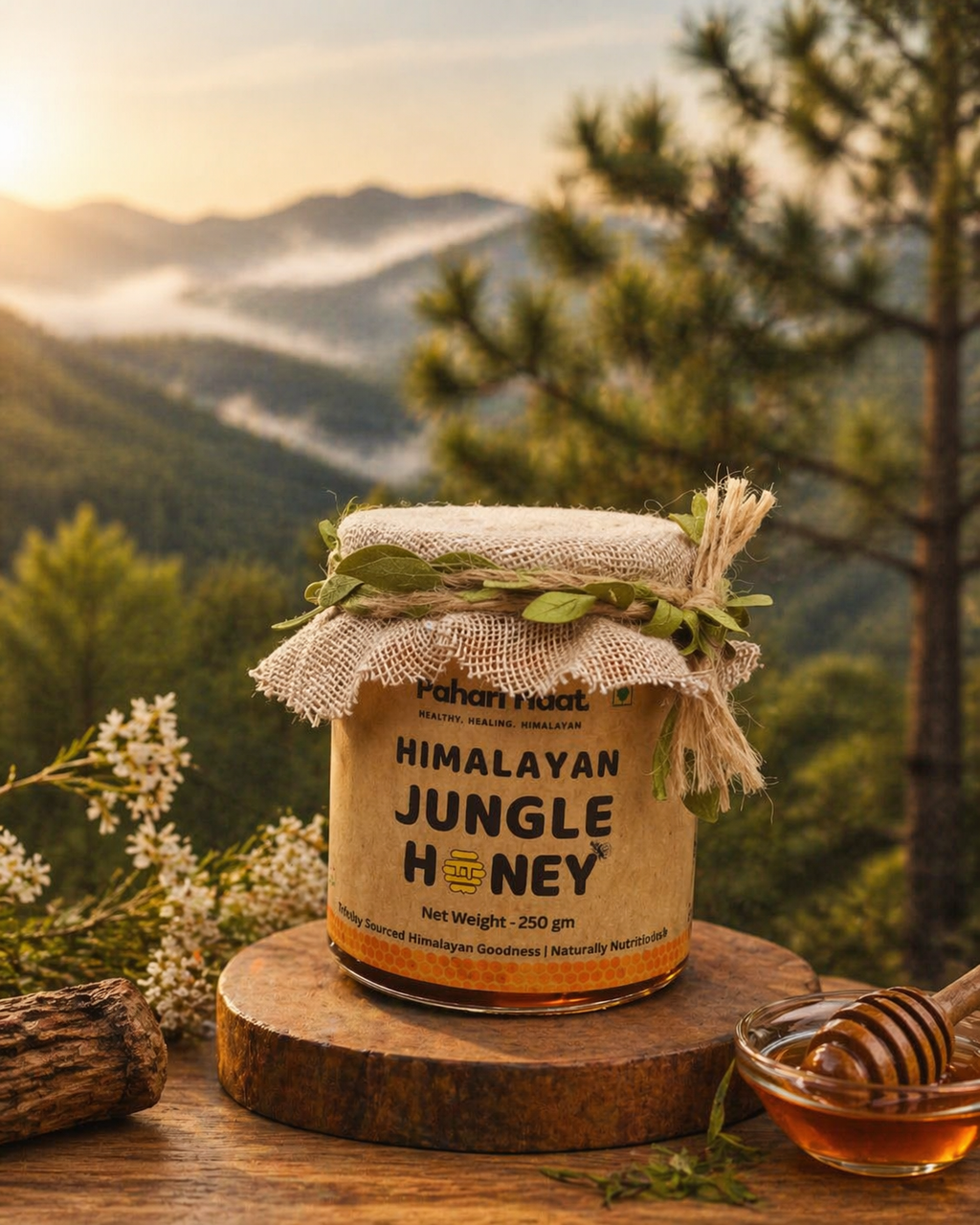
Pahari Haat Himalayan Jungle Honey is sourced from exactly these wild forest zones — handpicked by Pahari women, packed at Kasar Devi, Almora, and delivered to your door with zero processing between the hive and the jar.
The honest answer: is any Indian honey perfect?
No brand can claim perfection — including us. NMR testing is expensive and not yet universal among small Indian producers. Organic certification for wild-harvested honey is complex. And even genuinely raw honey can show minor variation between batches because nature is not uniform.
What you can demand is transparency. Ask your honey brand: where exactly does this come from? What temperature does it reach during processing? Can you share your lab reports?
If they cannot answer, buy elsewhere.
We can answer every one of those questions. And we will keep answering them as we grow.
Shop Pahari Haat Himalayan Jungle Honey →
Frequently asked questions
Q: How do I know if honey is pure at home?
Check for natural crystallization over time, slow and heavy viscosity, complex layered aroma, and slow dissolution in water. These are indicators — not guarantees. The only guaranteed method is NMR lab testing.
Q: Which honey is best for daily use in India?
For daily use, look for raw, unprocessed, single-origin honey from a traceable source. Pahari Haat Himalayan Jungle Honey is ideal — naturally antibacterial, enzyme-rich, and safe for daily use in warm water, herbal teas, and as a natural sweetener.
Q: Is commercially processed honey as good as raw honey?
Commercially processed honey and raw honey are fundamentally different products. Commercial processing typically involves heating above 60°C and ultra-filtration — steps that improve shelf life and appearance but destroy natural enzymes, remove bee pollen, and reduce antioxidant content. Raw honey that is never heated retains all of these naturally occurring nutrients. For daily wellness use, genuinely raw and unprocessed honey delivers significantly more nutritional value.
Q: What is the difference between raw honey and organic honey?
Raw honey refers to processing — it has never been heated or ultra-filtered. Organic honey refers to farming — bees forage on pesticide-free, certified organic plants. A honey can be raw but not organic, or organic but not raw. The ideal is both. Pahari Haat honey is naturally raw; we are actively working toward formal organic certification.
Q: Why does my honey crystallize?
Crystallization is a sign of purity, not spoilage. Raw honey contains natural pollen grains that act as crystallization nuclei. The more pure and raw the honey, the more reliably it crystallizes. To reliquefy, place the jar in warm water below 50°C for 15–20 minutes.
About Pahari Haat: We are a women-led Himalayan wellness brand based in Kasar Devi, Almora, Uttarakhand — operating under Kartavya Karma Trust, Project Udyogini. Every product we make is sourced directly from Pahari farmers, artisans, and beekeepers. FSSAI certified.
Complete guide: Best Honey in India 2026 — Complete Buyer's Guide →